Latin: musculus auricularis superior
Overview
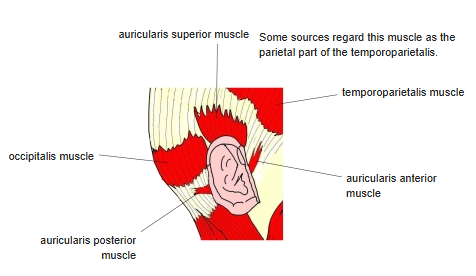
- The largest of the three auricular muscles (anterior, superior, posterior); thin and fan-shaped.
- One of the muscles around the auricle, in the middle, between the anterior and posterior auricular muscles.
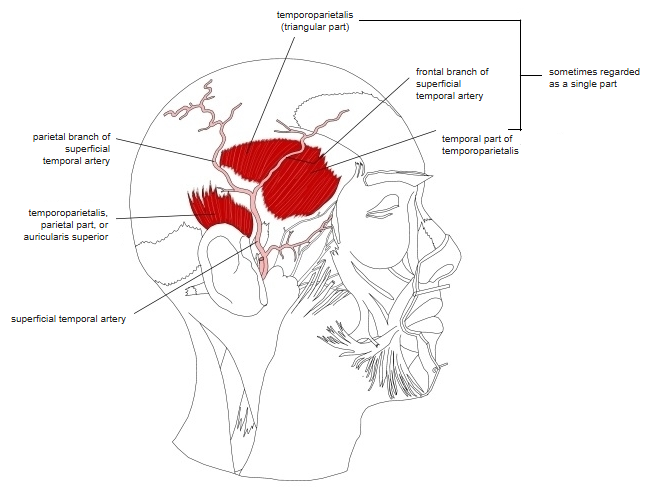
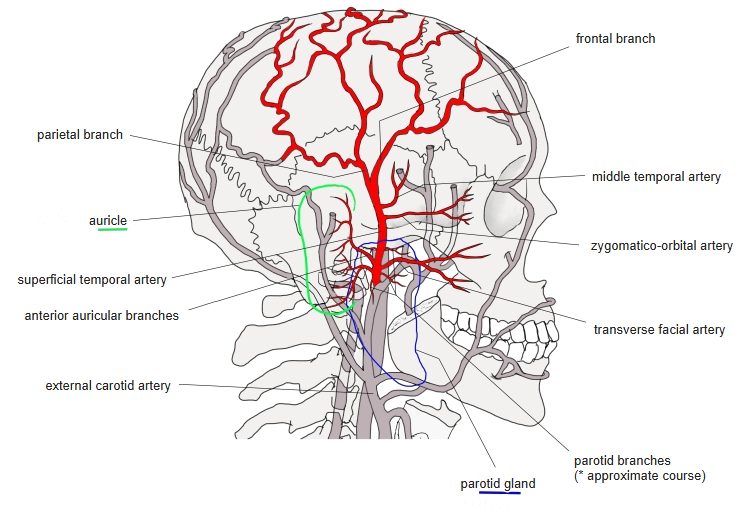
- It can also be regarded as the parietal part of the temporoparietalis, which is divided into three parts by the branches of the superficial temporal artery:
- Parts of the temporoparietalis
- Temporal part: the anterior part, arising from and ending in the galea aponeurotica
- Triangular part: the middle part, between the frontal and parietal branches of the superficial temporal artery
- Parietal part: formerly called the auricularis superior; from the galea aponeurotica, mostly to the cartilage of the auricle
- The temporal and triangular parts are sometimes regarded as a single part.
- In humans the auricular muscles are small and largely vestigial.
Position in the classification
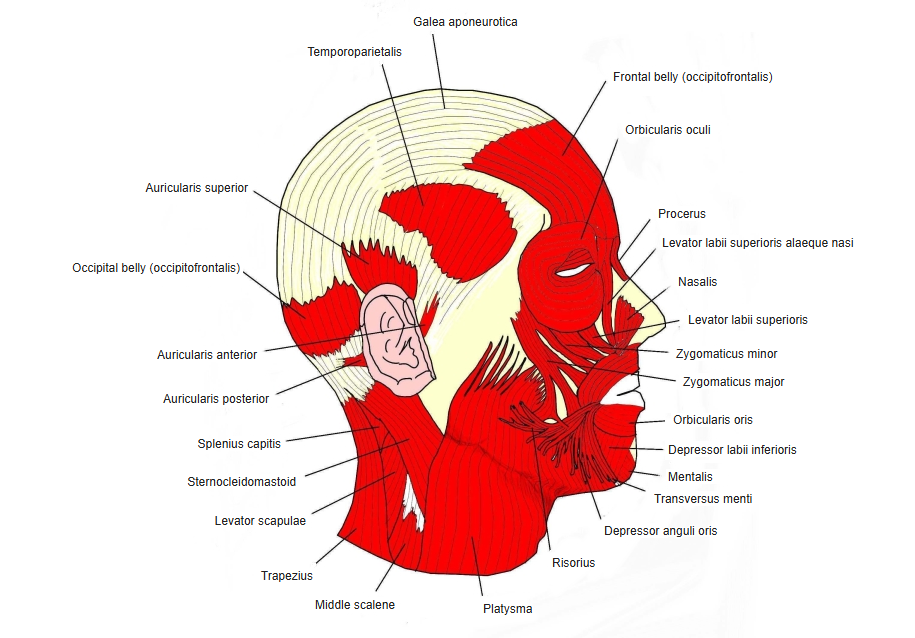
Head › Facial muscles › Muscles around the auricle
- Auricularis anterior
- Auricularis superior
- Auricularis posterior
Illustrations
Origin / insertion
- Origin: galea aponeurotica
- Insertion: upper part of the cartilage of the auricle (its cranial surface), by a thin flat tendon
Action
- Slightly raises the auricle
Innervation
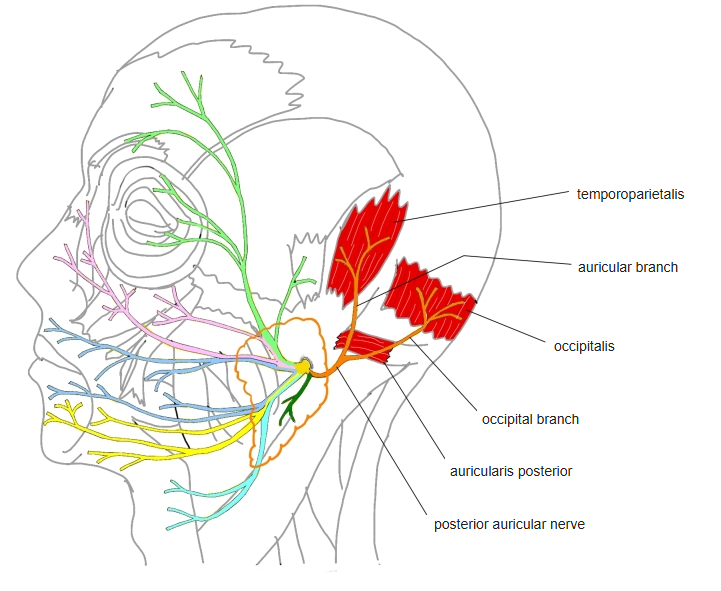
- Temporal branch of the facial nerve; some sources give the posterior auricular nerve
Blood supply
- Some sources give the posterior auricular artery; the branches of the superficial temporal artery also run over the muscle.
Related terms
- Auricularis anterior
- Auricularis posterior
- Temporoparietalis
- Galea aponeurotica
- Auricle
- Superficial temporal artery
- Facial nerve
References and sources
- Further reading: Superior auricular muscle, Wikipedia.