Latin: musculus iliocostalis thoracis · also called the iliocostalis dorsi
Overview
- It is the thoracic part of the iliocostalis, the lateral column of the erector spinae.
- The iliocostalis has three parts — cervicis, thoracis and lumborum.
- Its tendons of origin lie medial to the insertion tendons of the iliocostalis lumborum, which covers it.
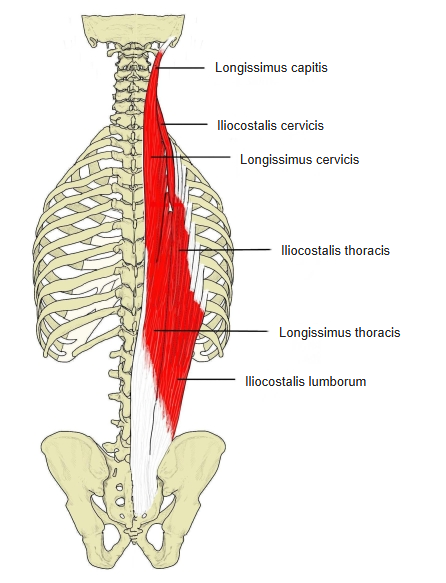
Position in the classification
Trunk › Back › Deep back muscles › Second layer › Intrinsic back muscles › Erector spinae
Illustrations
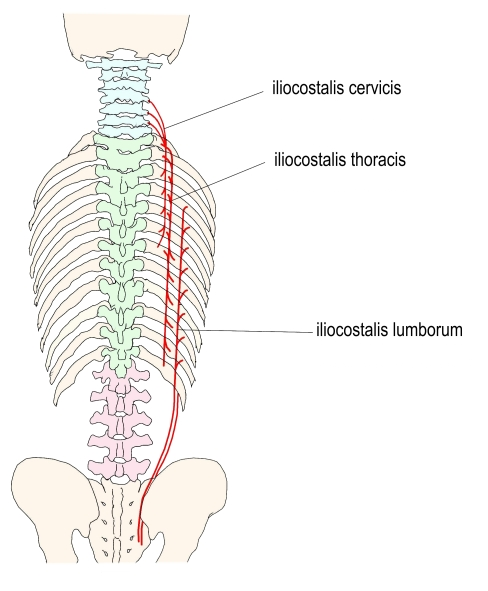
Origin / insertion
- Origin: upper borders of ribs 12 to 7 (the angles of the lower six ribs), medial to the attachments of the iliocostalis lumborum
- Insertion: upper borders of the angles of the upper six ribs (ribs 1–6) and the back of the transverse process of the seventh cervical vertebra
Action
- Bilateral: extends the thoracic vertebral column
- Unilateral: laterally flexes the vertebral column to the same side
These are the usual actions of the erector spinae.
Innervation
- Lateral branches of the posterior (dorsal) rami of the spinal nerves
Blood supply
- Posterior branches of the intercostal arteries and the lumbar arteries
Related terms
- Iliocostalis cervicis
- Iliocostalis lumborum
- Longissimus thoracis
- Erector spinae
- Angle of rib
References and sources
- Further reading: Iliocostalis, Wikipedia.