Latin: plexus entericus
Overview
- The networks of neurons in the wall of the digestive tract, from the upper oesophagus to the anal sphincters: the enteric nervous system.
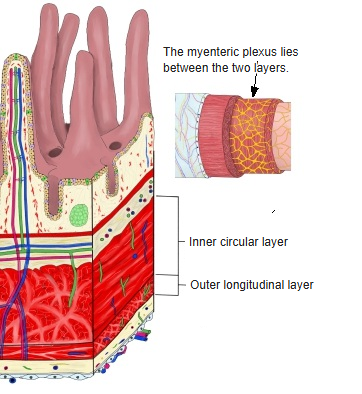
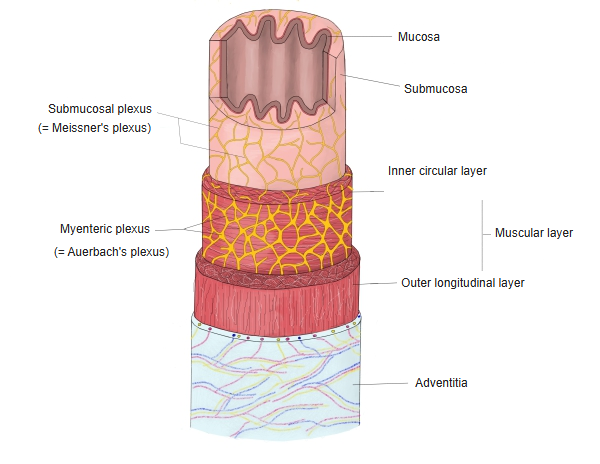
- Main parts: the myenteric (Auerbach's) plexus between the muscle layers, the submucosal (Meissner's) plexus and a mucosal plexus.
- They contain sensory, interneurons and motor neurons, so they can produce peristalsis and control secretion without input from the brain – hence the name "second brain".
Myenteric plexus in the intestinal wall 
Enteric plexuses of the oesophagus
Extrinsic nerves
| Division | Route | Effect |
|---|---|---|
| Parasympathetic | Vagus nerve (stomach, small intestine, part of colon); pelvic splanchnic nerves (sigmoid colon, rectum) | Increases motility and secretion |
| Sympathetic | Celiac, superior mesenteric and inferior mesenteric plexuses | Decreases peristalsis and secretion, reduces blood flow |
Development along the gut
- Least developed in the oesophagus (much of its upper part is striated muscle).
- Well developed in the stomach, duodenum, jejunum, caecum, colon and especially the rectum (defecation reflex).
- The subserous plexus, where extrinsic fibres enter, is usually not counted as part of the enteric nervous system.
References and sources
- Further reading: Enteric nervous plexuses, Wikipedia.