Greater horn (Latin: cornu majus ossis hyoidei)
Also called the greater cornu of hyoid bone
One of the three parts of the hyoid bone: a long, flattened bar that projects backwards and upwards from each end of the body. It tapers backwards, and its rear end is slightly thickened into a small, rounded tubercle.
bone
- Body : the oblong, flat plate of bone in the middle.
- Greater horn : projects backwards and upwards from each lateral end of the body.
- Lesser horn : a small cone that projects upwards and backwards from the junction of the body and the greater horn.
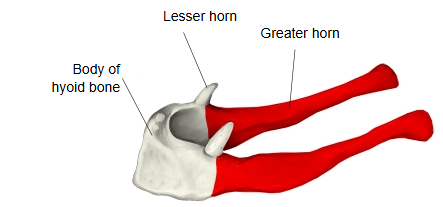
More details
Joint between the greater horn and the body
A cartilaginous joint (synchondrosis) or, sometimes, a small synovial joint. The two usually fuse by bone in middle age; sources differ on how often a joint persists.
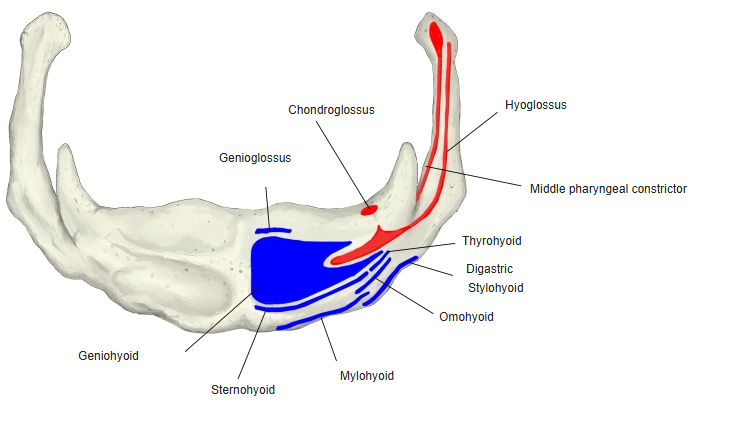
Muscles attached
The following two muscles arise from the greater horn. The thyrohyoid is inserted along its lower border; the upper border gives attachment to the thyrohyoid membrane and the tip to the thyrohyoid ligament. The greater horn can be felt on each side of the neck, above the thyroid cartilage, when the hyoid is steadied between finger and thumb.
| 1 | Hyoglossus | musculus hyoglossus |
| 2 | Middle pharyngeal constrictor | musculus constrictor pharyngis medius |
Reference websites
[Wikipedia]
· Hyoid bone, Wikipedia.
[Websites with illustrations]
· Hyoid bone (Kenhub)
· Hyoid bone (Radiopaedia)
Where it is found
Related terms
References and sources
- Further reading: Hyoid bone, Wikipedia.
- Federative International Programme for Anatomical Terminology (FIPAT). Terminologia Anatomica, 2nd ed. (TA2), 2019.