Infrahyoid muscles (Latin: musculi infrahyoidei)
Also called the strap muscles
- Members
- Muscles attached to the hyoid ≠ hyoid muscles
- Reference websites
- (Wikipedia, websites with illustrations)
- Where it is found
- Related terms
The muscles of the neck attached to the hyoid bone are called the hyoid muscles. The four (sometimes counted as three) that run downwards from the hyoid bone are the infrahyoid muscles; the four that run upwards from it are the suprahyoid muscles.
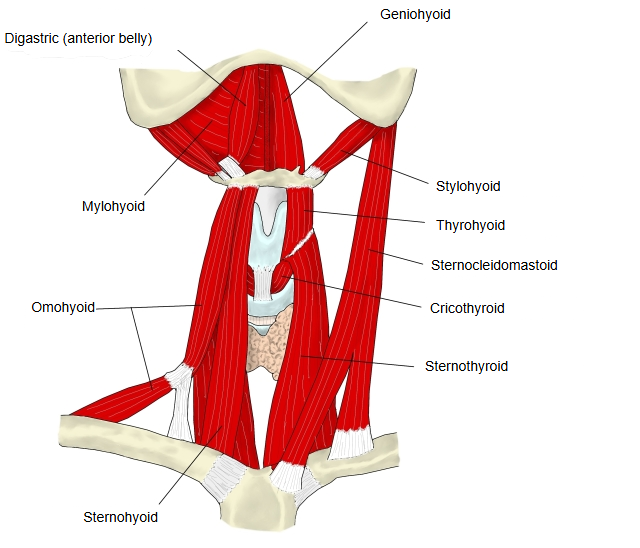
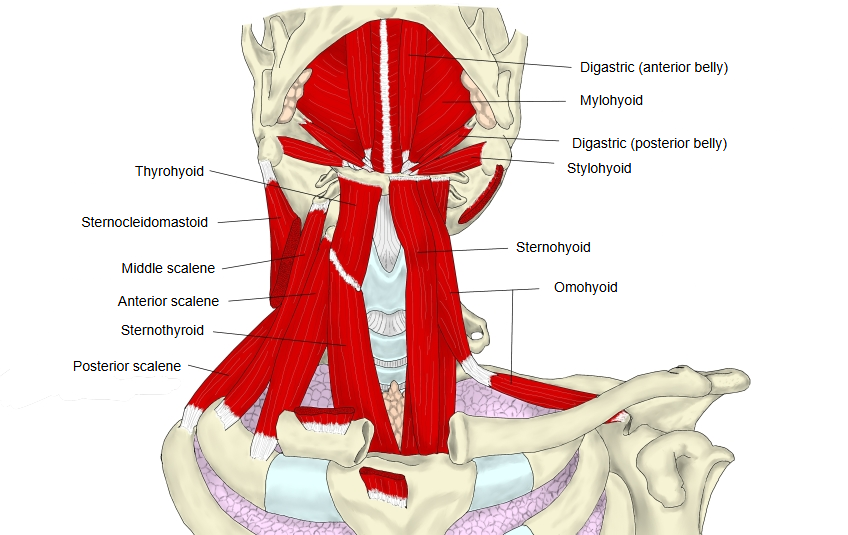
- Suprahyoid muscles : the four muscles that run upwards from the hyoid bone: digastric, stylohyoid, mylohyoid and geniohyoid.
- Infrahyoid muscles : the four (or three) muscles that run downwards from the hyoid bone: sternohyoid, omohyoid, sternothyroid and thyrohyoid.
Members
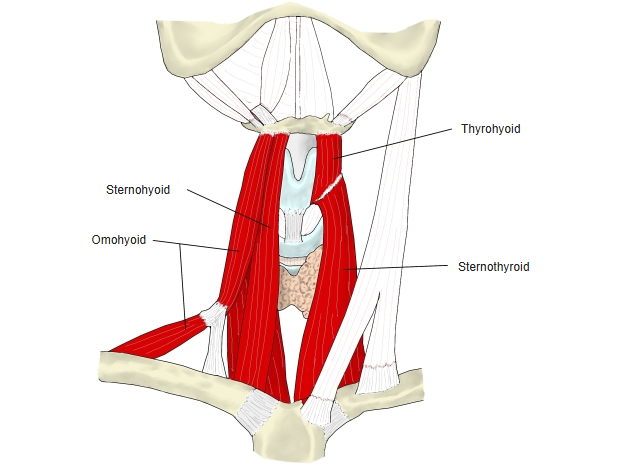
The infrahyoid muscles are the following four muscles.
| Infrahyoid muscles | 1 | Thyrohyoid | musculus thyrohyoideus |
| 2 | Omohyoid | musculus omohyoideus | |
| 3 | Sternohyoid | musculus sternohyoideus | |
| 4 | Sternothyroid | musculus sternothyroideus |
Note: the sternothyroid does not actually reach the hyoid bone (it ends on the thyroid cartilage), so some sources leave it out of the infrahyoid muscles and count only three.
Sternohyoid: from the back of the manubrium of the sternum and the medial end of the clavicle to the body of the hyoid bone.
Omohyoid: two bellies joined by an intermediate tendon. The inferior belly arises from the upper border of the scapula, near the suprascapular notch; the superior belly inserts on the body of the hyoid. A fascial sling holds the tendon down towards the clavicle.
Sternothyroid: deep to sternohyoid, from the back of the manubrium to the oblique line of the thyroid cartilage. It ends on the larynx, not on the hyoid.
Thyrohyoid: a short muscle that continues the line of sternothyroid upwards, from the oblique line of the thyroid cartilage to the body and greater horn of the hyoid; the thyrohyoid membrane lies deep to it.
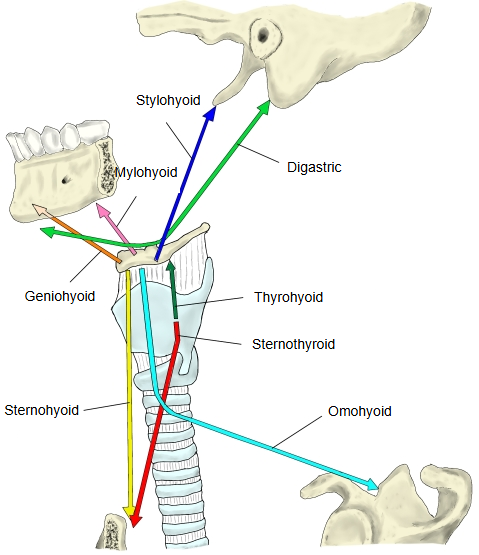
They lie in two layers in front of the larynx, the trachea and the thyroid gland: sternohyoid and omohyoid superficially, sternothyroid and thyrohyoid deeper. Together they lower the hyoid bone and the larynx, for example after swallowing, and hold the hyoid steady so that the suprahyoid muscles can open the mouth.
Nerve supply: sternohyoid, omohyoid and sternothyroid are supplied by the ansa cervicalis (C1 to C3); thyrohyoid by fibres of the first cervical nerve carried with the hypoglossal nerve.
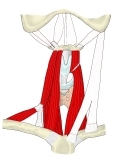 Infrahyoid muscles (anterior)
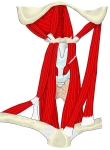 Muscles of the front of the neck
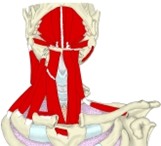 Neck muscles (anterior, from below)
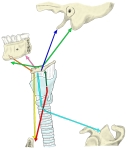 Lines of pull of the hyoid muscles
Note
Besides the eight muscles above, four more muscles are attached to the hyoid bone. They belong to the tongue or the pharynx, not to the muscles of the neck, so they are not counted among the hyoid muscles. This is worth keeping in mind.
Muscles attached to the hyoid ≠ hyoid muscles
| 1 | Genioglossus | musculus genioglossus | Extrinsic muscles of the tongue | 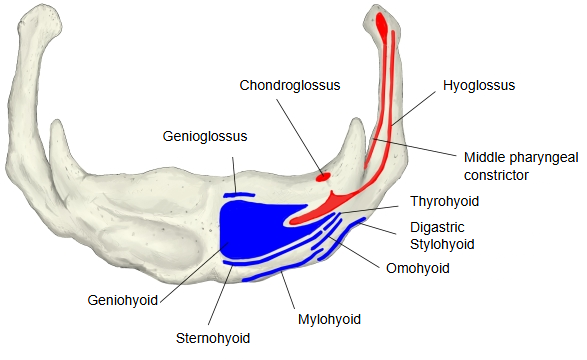 |
| 2 | Chondroglossus | musculus chondroglossus | ||
| 3 | Hyoglossus | musculus hyoglossus | ||
| 4 | Middle pharyngeal constrictor | musculus constrictor pharyngis medius | Muscles of the pharynx |
Reference websites
[Wikipedia]
· Infrahyoid muscles, Wikipedia.
· Ansa cervicalis, Wikipedia.
· Hyoid bone, Wikipedia.
[Websites with illustrations]
· The infrahyoid muscles (TeachMeAnatomy)
· Muscles of the neck, lateral view (Gray's Anatomy) (Wikimedia Commons)

Where it is found
Related terms
References and sources
- Further reading: Infrahyoid muscles, Wikipedia.
- Further reading: Ansa cervicalis, Wikipedia.
- Federative International Programme for Anatomical Terminology (FIPAT). Terminologia Anatomica, 2nd ed. (TA2), 2019.