Lateral surface of fibula (Latin: facies lateralis fibulae)
One of the three surfaces of the shaft of the fibula: the surface bounded by the anterior border and the posterior border.
It is broad and fairly smooth, and often forms a shallow groove.
The lateral surface of the fibula is where the fibular muscles arise, between the anterior and posterior intermuscular septa of the leg (the lateral compartment of the leg). Its upper half is shallowly hollowed by the origin of fibularis longus.
the shaft
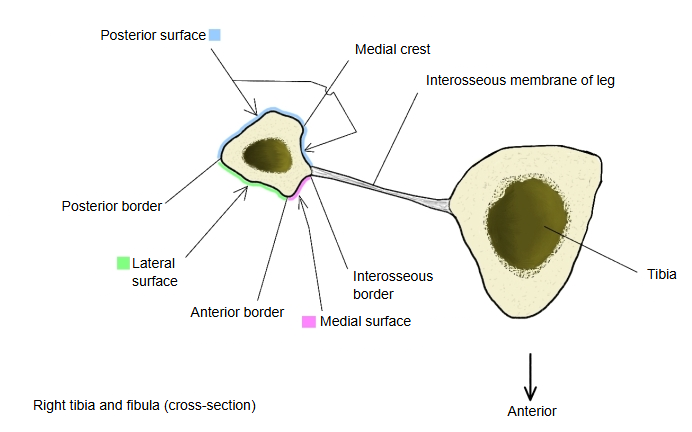
- Medial surface : : the narrow surface between the anterior border and the interosseous border, facing medially
- Lateral surface : : the fairly smooth surface between the anterior border and the posterior border
- Posterior surface : : the surface between the posterior border and the interosseous border; the medial crest runs on it
 Right tibia and fibula (cross-section)
 Right fibula (anterior)
 Right fibula (posterior)
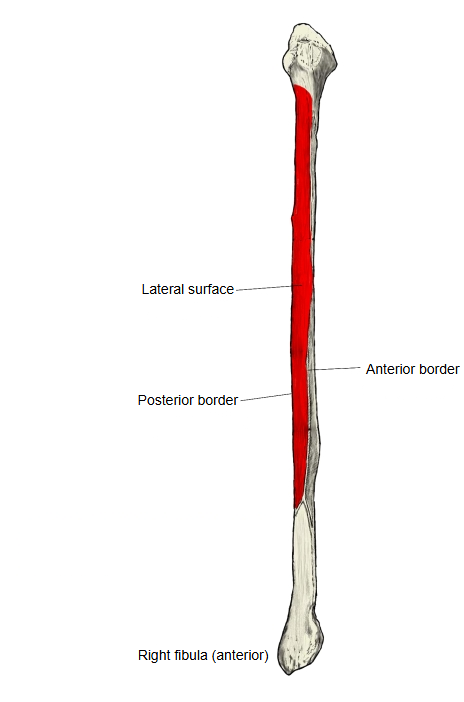
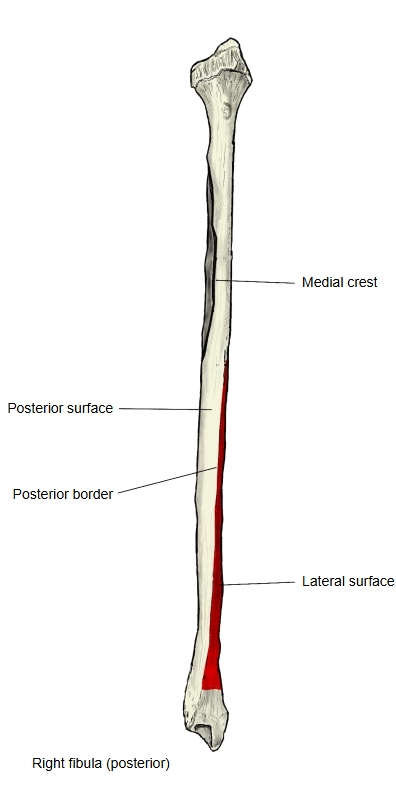
It faces laterally in its upper two-thirds and twists to face backwards in its lower third, where it runs on into the groove behind the lateral malleolus. It gives origin to fibularis longus (mainly the upper part) and fibularis brevis (the lower part).
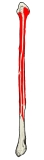 Muscle attachments (anterior)
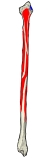 Muscle attachments (posterior)
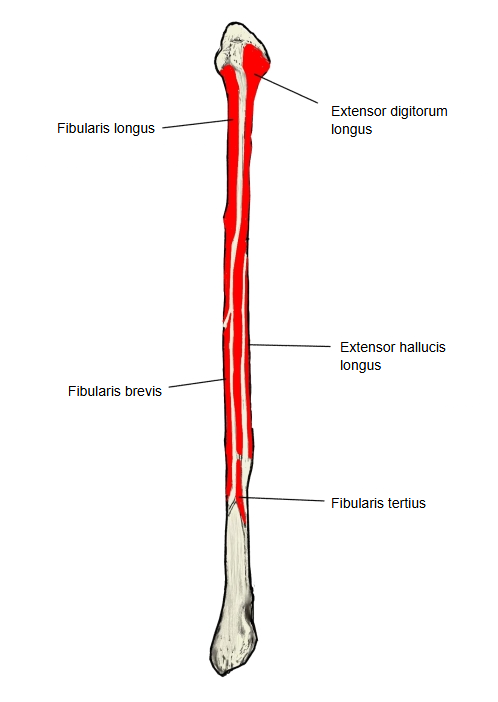
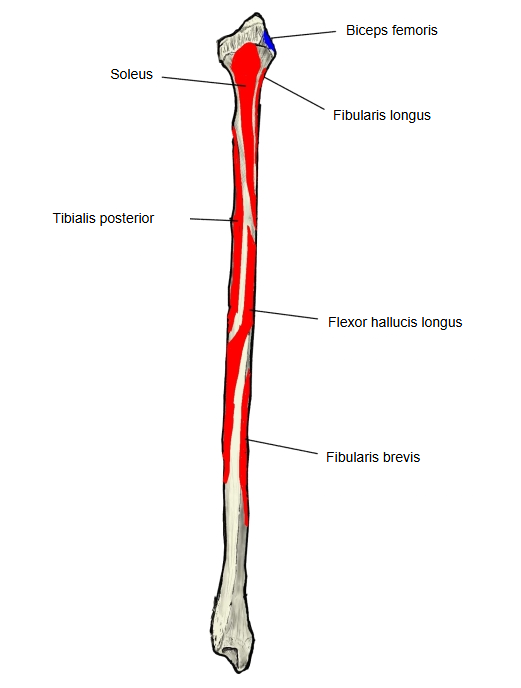
Attachments
| Muscles | 1 | Fibularis longus (peroneus longus) |
| 2 | Fibularis brevis (peroneus brevis) |
Reference websites
[Wikipedia]
· Fibula, Wikipedia.
· Lateral compartment of leg, Wikipedia.
[Websites with illustrations]
· Bones of the right leg, anterior surface (Gray's Anatomy, fig. 258) (Wikimedia Commons)

· Bones of the right leg, posterior surface (Gray's Anatomy, fig. 259) (Wikimedia Commons)

Where it is found
Related terms
- Shaft of fibula
- Anterior border of fibula
- Posterior border of fibula
- Medial surface of fibula
- Posterior surface of fibula
- Malleolar groove of fibula
- Lateral malleolus
References and sources
- Further reading: Fibula, Wikipedia.
- Further reading: Lateral compartment of leg, Wikipedia.
- Federative International Programme for Anatomical Terminology (FIPAT). Terminologia Anatomica, 2nd ed. (TA2), 2019.