Latin: musculus longissimus cervicis
Overview
- One of the three parts of the longissimus (capitis, cervicis, thoracis), which belongs to the erector spinae.
- Lies medial to the longissimus thoracis; arises by long, thin tendons from the upper thoracic transverse processes and inserts by similar tendons into the cervical transverse processes.
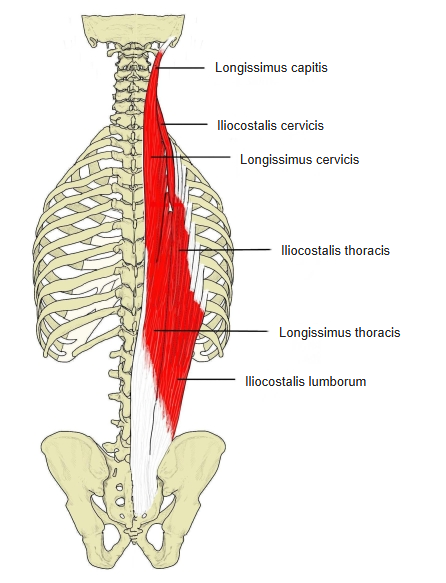
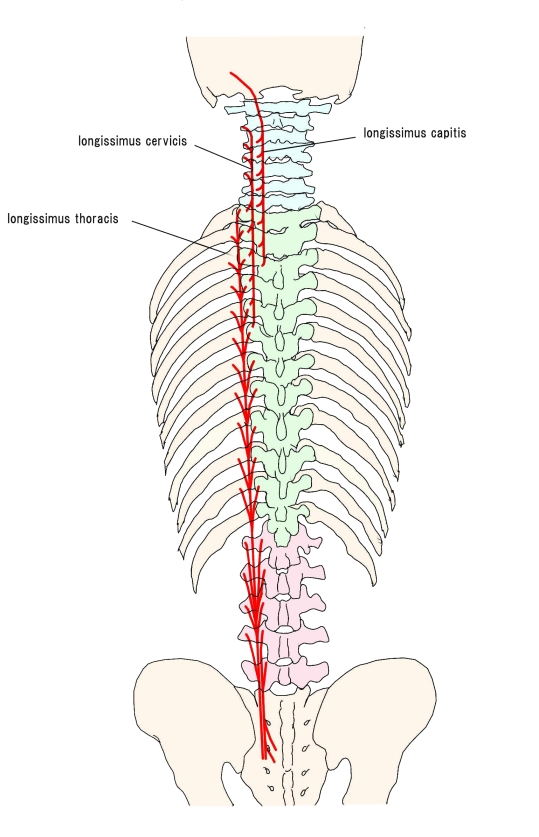
Position in the classification
Trunk › Back › Deep back muscles › Second layer › Intrinsic back muscles › Erector spinae
Origin / insertion
- Origin: transverse processes of the upper four to six thoracic vertebrae; often additional slips from the roots of the transverse processes of C3–C6 (C7)
- Insertion: posterior tubercles of the transverse processes of C2–C6 (sometimes also C1)
Sources differ slightly on the exact levels (T1–T4/5 to C2 (C1)–C6, or the upper six thoracic vertebrae to C2–C5).
Action
- Acting on both sides: extends the neck
- Acting on one side: bends the neck to the same side
Innervation
- Lateral branches of the posterior rami of the spinal nerves
Blood supply
- Deep cervical artery (from the costocervical trunk); dorsal branches of the upper posterior intercostal arteries
Related terms
- Longissimus
- Longissimus thoracis
- Longissimus capitis
- Erector spinae
- Iliocostalis cervicis
References and sources
- Further reading: Longissimus, Wikipedia.
- Gray H. Anatomy of the Human Body, 20th ed. (1918), “6a. The Deep Muscles of the Back”, Bartleby.com.