Latin: omentum majus
Overview
- Large, apron-like fold of peritoneum hanging from the greater curvature of the stomach in front of the intestines.
- Folds back on itself and ascends to the transverse colon, so it is made of four layers of peritoneum.
- Usually thin with a lace-like look, but it can store a lot of fat.
- The first structure seen when the abdomen is opened from the front.
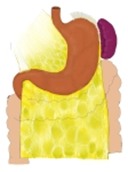
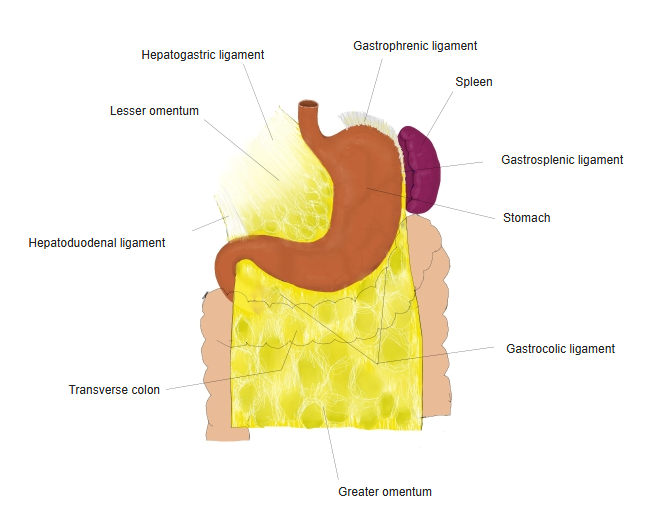
Greater and lesser omentum 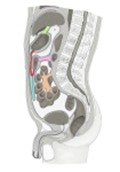
Peritoneum in a median section
Layers and formation
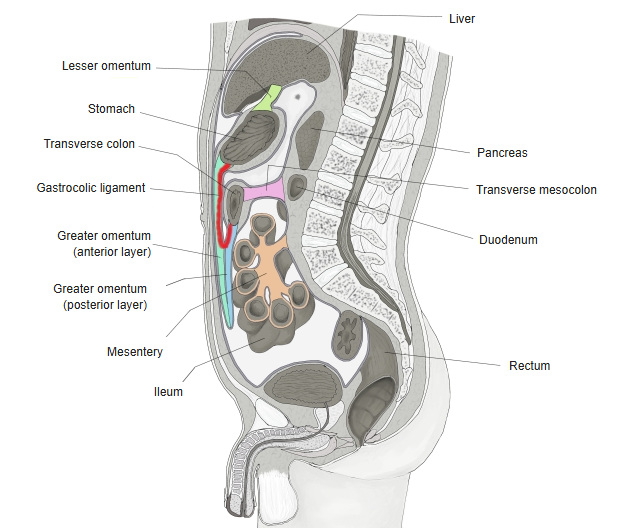
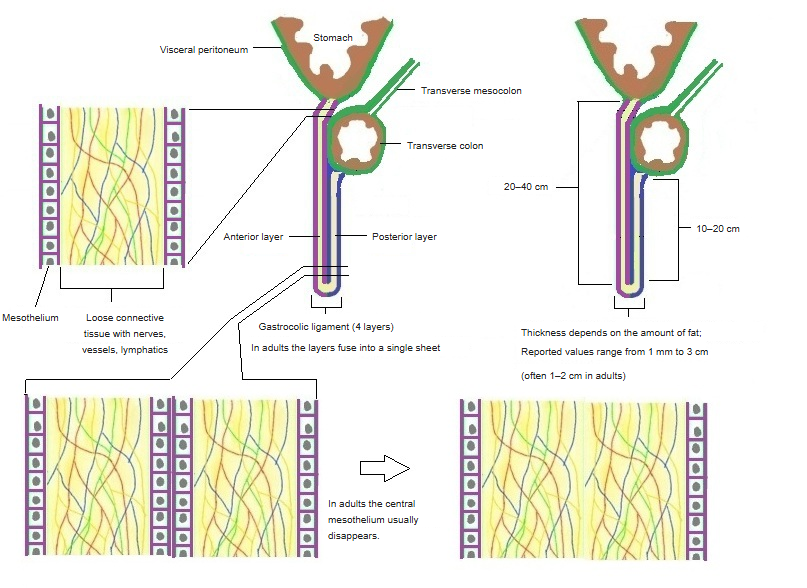
- 1. The visceral peritoneum of the front and back of the stomach meets at the greater curvature and hangs down as a double sheet with fat, vessels, nerves and lymphatics (the anterior layer).
- 2. At its lower edge it folds back and runs up as the posterior layer, close behind the anterior layer.
- 3. The posterior layer reaches the transverse colon and fuses with its visceral peritoneum and the transverse mesocolon.
- In the adult the four layers fuse into one sheet and the potential space between them (part of the omental bursa) disappears.
- The hanging part is commonly 20–40 cm long; its thickness depends on the amount of fat.
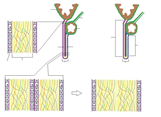
Layers of the greater omentum 
Omenta in a sagittal diagram
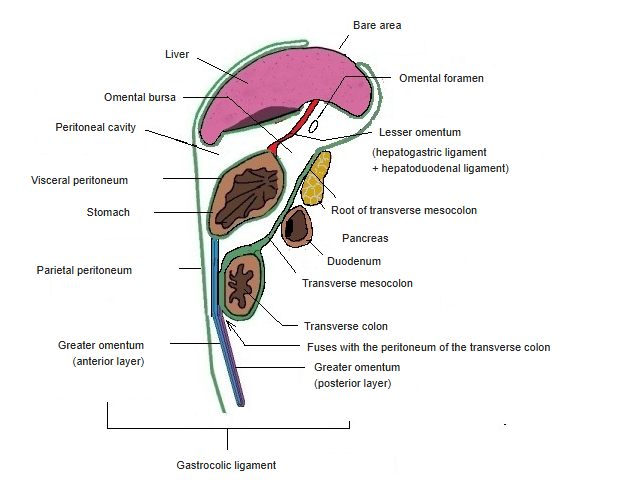
Parts
| Part | Between |
|---|---|
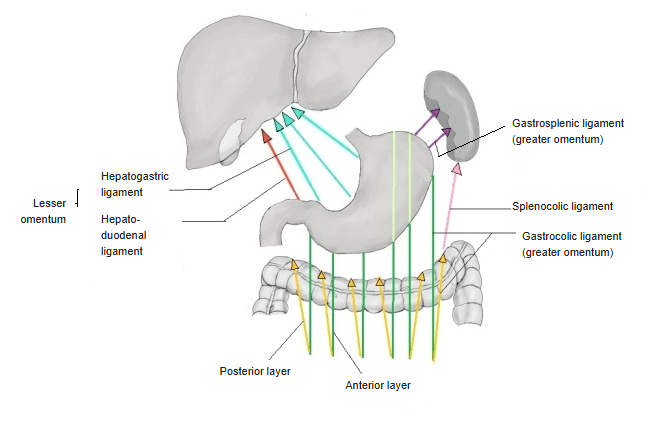
| Gastrocolic ligament | Greater curvature of the stomach and the transverse colon |
| Gastrosplenic ligament | Greater curvature and the hilum of the spleen; carries the short gastric and left gastro-omental vessels |
| Gastrophrenic ligament | Upper part of the greater curvature and the diaphragm |
| Splenorenal ligament | Spleen and the front of the left kidney; carries the splenic vessels and the tail of the pancreas |
Parts of the lesser and greater omentum
Vessels and function
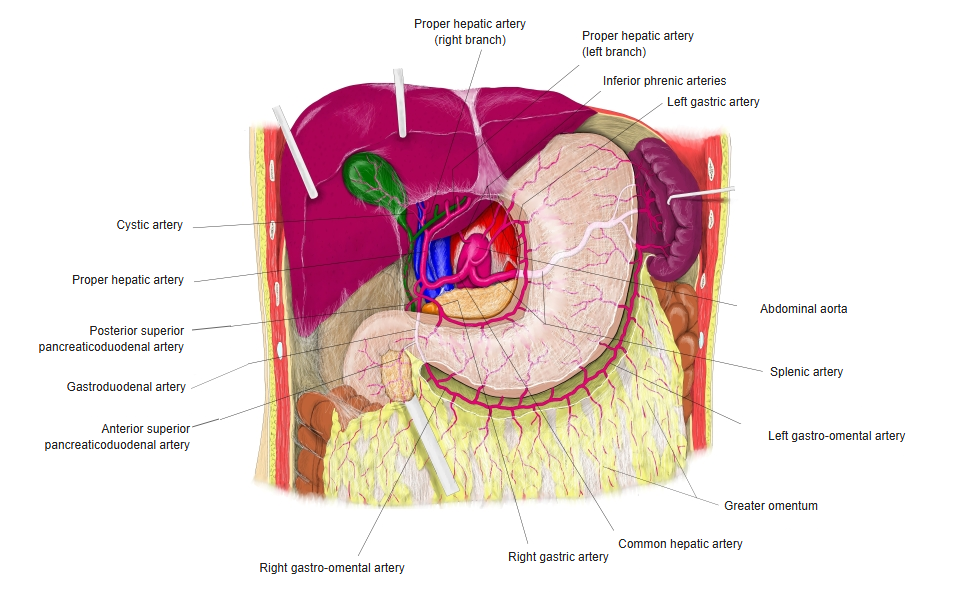
- Arteries: right and left gastro-omental (gastroepiploic) arteries along the greater curvature, from the gastroduodenal and splenic arteries, with omental branches running down into the apron.
- Veins: follow the arteries to the hepatic portal system.
- Defence: contains clusters of immune cells ("milky spots"); it often moves to and seals off areas of inflammation, earning the name "policeman of the abdomen".
- Fat storage and cushioning of the intestines.
Greater omentum and the arteries of the stomach
References and sources
- Further reading: Greater omentum, Wikipedia.