Gastrophrenic ligament (Latin: ligamentum gastrophrenicum)
- Overview
- Reference sites
- Reference websites
- (Wikipedia, websites with illustrations)
- Where it is found
- Related terms
Overview
It is a fairly thin membrane; no large blood vessels, lymphatic vessels or nerves run in it.
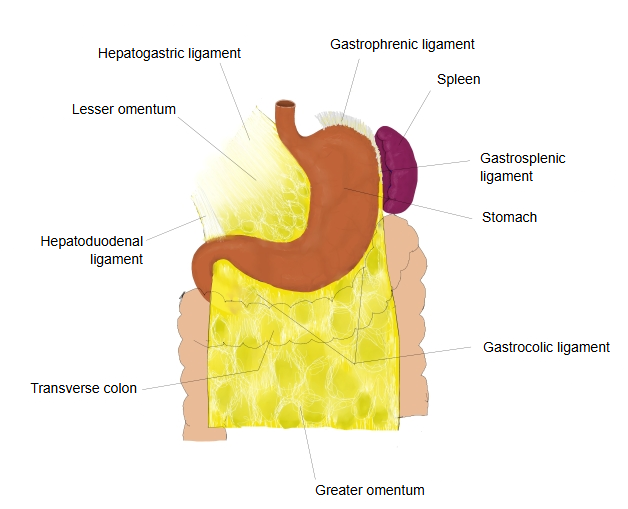
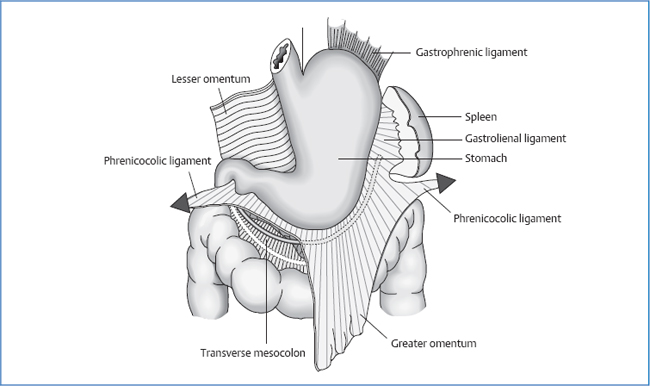
It is the upward continuation of the gastrosplenic ligament and joins the stomach to the diaphragm.
It continues the gastrosplenic ligament upwards along the greater curvature and ends to the left of the esophagus near the cardia. Its two layers part as they reach the stomach, leaving a small bare area on the posterior surface close to the cardiac orifice; this area has no peritoneal covering and lies directly against the diaphragm and often the upper part of the left suprarenal gland.
It helps hold the fundus of the stomach up under the left dome of the diaphragm. It is usually a short, thin fold; sources differ on where it ends and the gastrosplenic ligament begins, and on how it relates to the peritoneal folds around the esophagus.
omentum
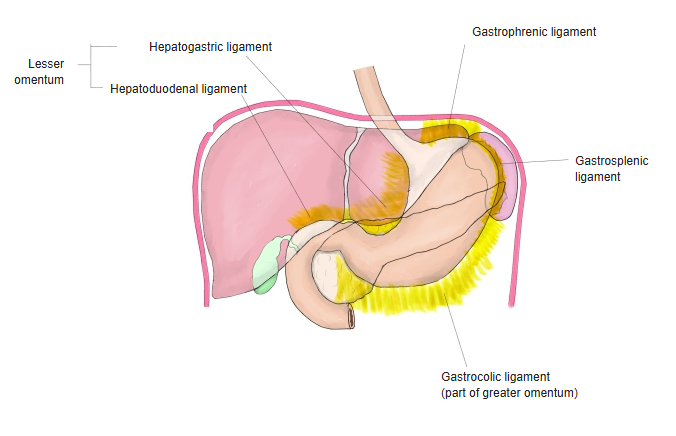
- Gastrocolic ligament : the curtain-like fold that hangs down and forms most of the greater omentum; rich in fat.
- Gastrosplenic ligament : between the upper part of the greater curvature (especially from the fundus to the upper greater curvature) and the spleen (hilum).
- Gastrophrenic ligament : from near the uppermost part of the greater curvature to the underside of the left part of the diaphragm.
- Splenorenal ligament : between the spleen (medial side, near the hilum) and the front of the left kidney. Some sources count it as part of the greater omentum, because it develops from the same structure; others call it one of the peritoneal ligaments.
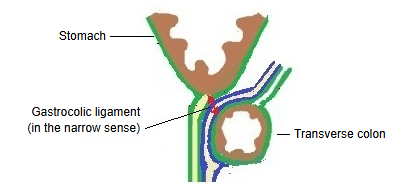
Note: in the strict sense, the gastrocolic ligament is only the part of the greater omentum between the stomach and the transverse colon (not the apron that hangs down and folds back up), as in the drawing below. In that case the grouping above no longer fits exactly.
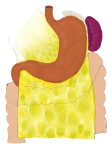 Lesser and greater omenta (anterior)
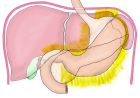 Peritoneal folds around the stomach
Reference sites
Reference websites
[Wikipedia]
· Gastrophrenic ligament, Wikipedia.
· Greater omentum, Wikipedia.
[Websites with illustrations]
· Peritoneal folds attached to the stomach (figure) (AnatomyQA)

· Ligaments of the stomach (figure) (Pinterest)

· Peritoneal relations of the stomach (figure) (Musculoskeletal Key)
Where it is found
Related terms
- Gastrosplenic ligament
- Gastrocolic ligament
- Greater omentum
- Cardia
- Fundus of stomach
- Diaphragm
- Stomach
References and sources
- Further reading: Gastrophrenic ligament, Wikipedia.
- Further reading: Greater omentum, Wikipedia.
- Federative International Programme for Anatomical Terminology (FIPAT). Terminologia Anatomica, 2nd ed. (TA2), 2019.