Latin: penis
Overview
- External male organ for urination and copulation.
- Formed by three erectile bodies: two corpora cavernosa and one corpus spongiosum around the urethra.
- Divided into a root fixed in the perineum, a body and the glans at the tip.
- Erection occurs when the erectile tissue fills with blood (parasympathetic, pelvic splanchnic nerves).
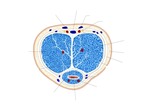
Cross-section of the penis
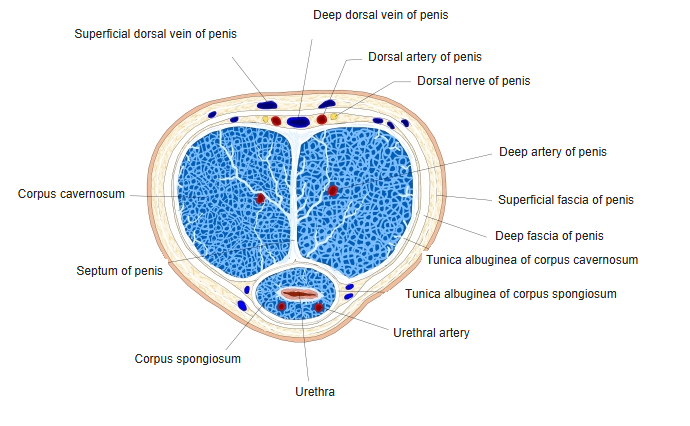
Structure
| Part | Description |
|---|---|
| Corpora cavernosa | Paired dorsal erectile bodies; their crura attach to the ischiopubic rami; each contains a deep artery |
| Corpus spongiosum | Ventral erectile body containing the spongy urethra; enlarged behind as the bulb and in front as the glans |
| Tunica albuginea | Dense fibrous coat around each erectile body |
| Fasciae | Deep fascia of the penis (Buck's fascia) around all three bodies; superficial fascia under the skin |
| Prepuce | Fold of skin covering the glans |
Male pelvis and perineum (lateral view)
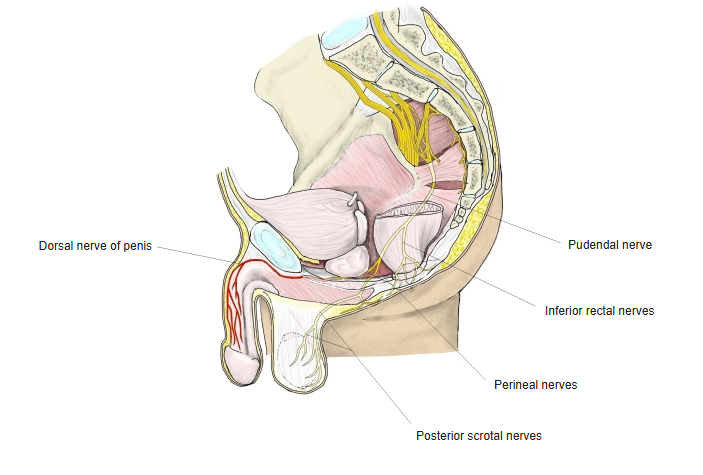
Vessels and nerves
- Arteries: deep, dorsal and bulbourethral arteries from the internal pudendal artery.
- Veins: deep dorsal vein (to the prostatic plexus) and superficial dorsal vein.
- Nerves: dorsal nerve of the penis (sensory, from the pudendal nerve); autonomic cavernous nerves.
- Muscles at the root: bulbospongiosus and ischiocavernosus.
References and sources
- Further reading: Penis, Wikipedia.