Latin: corpus ciliare
Overview
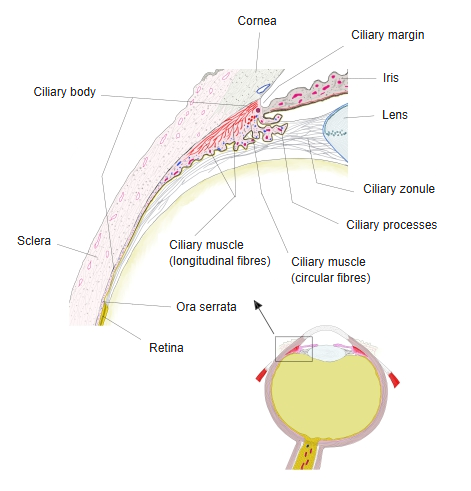
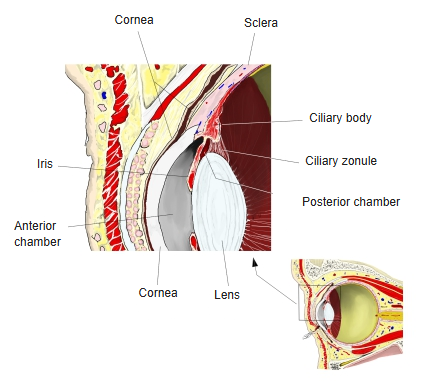
- The middle part of the vascular layer: a ring-shaped thickening between the choroid (at the ora serrata) and the root of the iris.
- Triangular in a meridional section, with its base towards the iris.
- Holds the lens by the ciliary zonule and changes its shape for near and far vision (accommodation).
- Its processes make the aqueous humor.
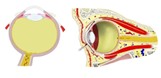
Ciliary body in horizontal sections 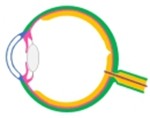
Eyeball, horizontal section (diagram)
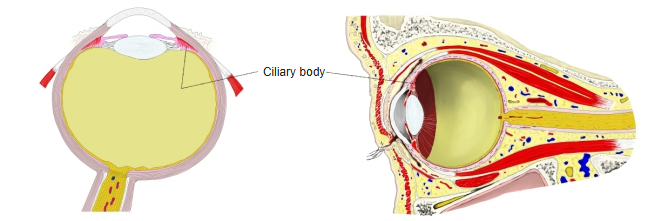
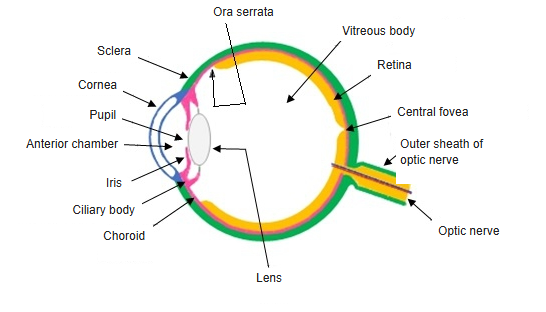
Parts and structure
| Part | Features |
|---|---|
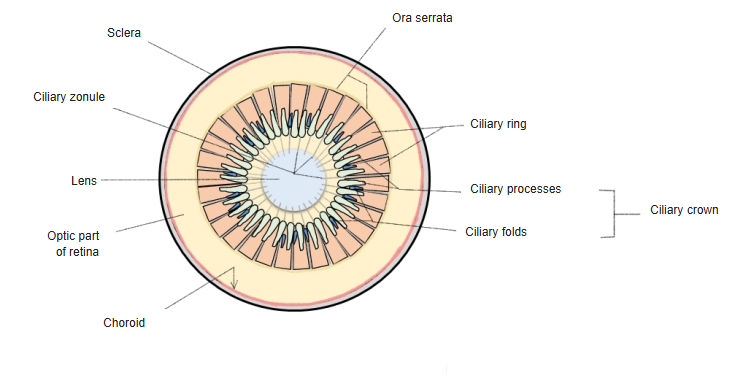
| Ciliary ring (orbiculus ciliaris) | Flat posterior zone, about 3–4 mm wide, next to the ora serrata |
| Ciliary crown (corona ciliaris) | Folded anterior zone with about 70 radial ciliary processes and smaller ciliary folds between them |
| Ciliary muscle | Smooth muscle with meridional (longitudinal), radial and circular fibres |
| Ciliary epithelium | Ciliary part of the retina: an outer pigmented and an inner non-pigmented layer; the non-pigmented layer secretes aqueous humor |
| Ciliary zonule | Fine fibres from the ciliary processes and folds to the equator of the lens |
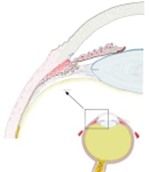
Ciliary body, meridional section 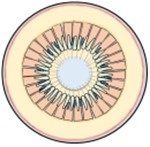
Ciliary body seen from inside (model)
Accommodation and nerve supply
- When the ciliary muscle contracts, the ring narrows, the zonule slackens and the elastic lens becomes rounder – the eye focuses on near objects.
- When the muscle relaxes, the zonule pulls the lens flatter for distant vision.
- The ciliary muscle is supplied by parasympathetic fibres of the oculomotor nerve, relayed in the ciliary ganglion and carried by the short ciliary nerves.
Front of the eyeball, sagittal section
References and sources
- Further reading: Ciliary body, Wikipedia.