Latin: humor aquosus
Overview
- The clear, watery fluid that fills the anterior and posterior chambers of the eye.
- Secreted by the non-pigmented epithelium of the ciliary processes of the ciliary body.
- Nourishes the lens and the back of the cornea, which have no blood vessels, and removes their waste.
- Its constant production and drainage keep the intraocular pressure (normally about 12–22 mmHg) and so the shape of the eye.
- Resembles a protein-poor plasma filtrate, rich in ascorbate; total volume only about 0.2–0.3 ml.
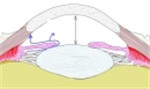
Flow of aqueous humor 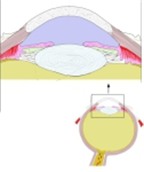
Anterior and posterior chambers
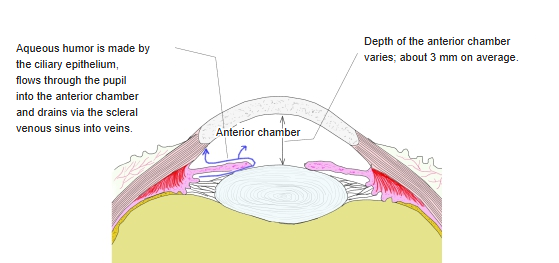
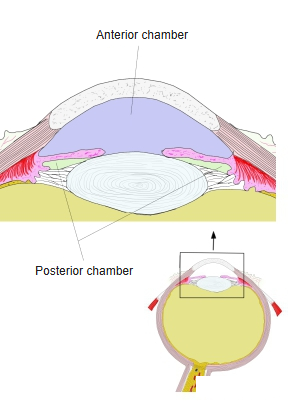
Production and drainage
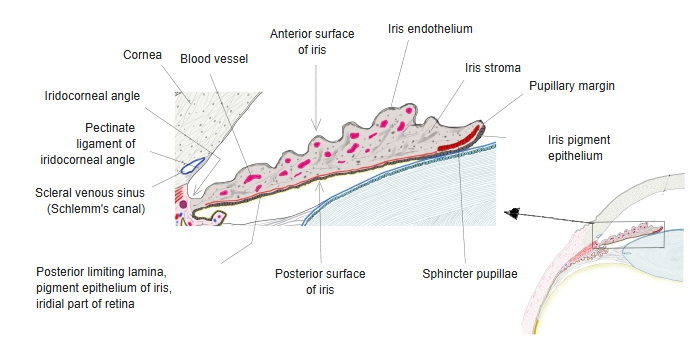
- Produced in the posterior chamber, it flows between the iris and lens, through the pupil into the anterior chamber.
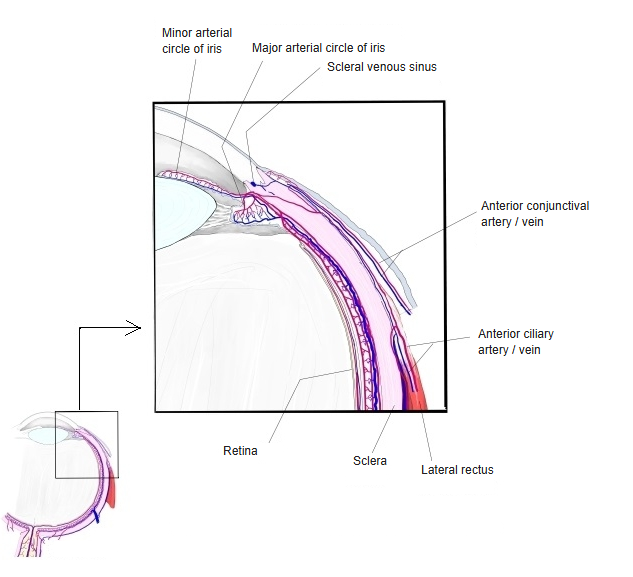
- Most of it leaves at the iridocorneal angle through the trabecular meshwork into the scleral venous sinus (Schlemm's canal), then into the anterior ciliary and episcleral veins.
- A smaller part seeps through the ciliary body into the suprachoroidal space (uveoscleral route).
- If the outflow is blocked, the pressure rises and can damage the optic nerve (glaucoma).
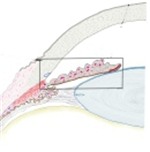
Iris, section 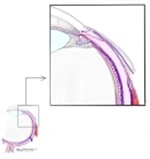
Arterial circles of the iris, section
References and sources
- Further reading: Aqueous humor, Wikipedia.