Latin: glandulae sudoriferae eccrinae
Overview
- The ordinary sweat glands: 2–4 million over almost the entire skin.
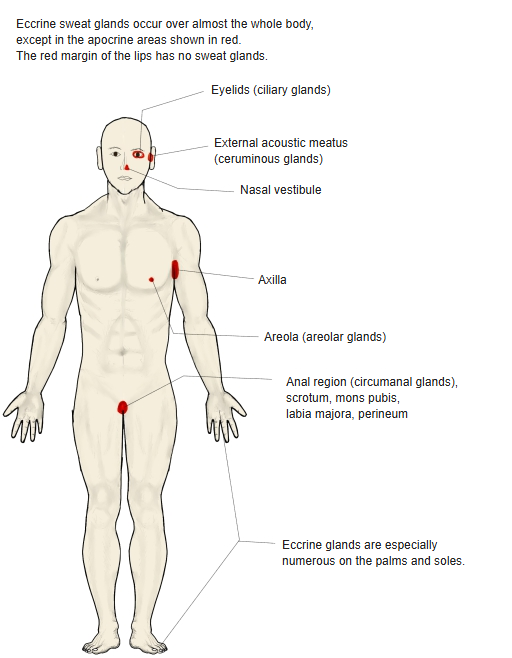
- Most numerous on the palms, soles and forehead; absent from the red margin of the lips, the nail bed, the nipple and parts of the external genitalia.
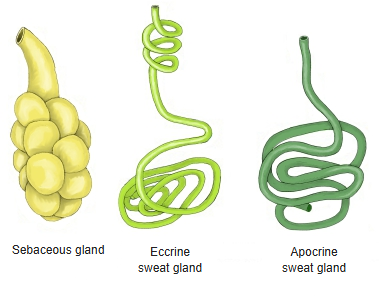
- A simple coiled tube: the secretory coil lies in the deep dermis; the duct runs straight up and spirals through the epidermis to a sweat pore.
- Their watery sweat cools the body by evaporation – up to several litres a day in heat.

Skin glands compared
Structure and function
- The secretory part has clear and dark cells surrounded by myoepithelial cells.
- The duct reabsorbs part of the sodium chloride, so sweat is hypotonic.
- Thermal sweating occurs over the whole body; emotional sweating appears mainly on the palms, soles and axillae.
- Supplied by sympathetic fibers that release acetylcholine.
Where apocrine glands occur
References and sources
- Further reading: Eccrine sweat glands, Wikipedia.