Latin: epidermis
Overview
- The outer layer of the skin: keratinized stratified squamous epithelium.
- Usually 0.05–0.2 mm thick; up to about 1.5 mm on the palms and soles.
- Has no blood vessels; it is nourished by diffusion from the dermis.
- Cells are made in the deepest layer and move to the surface, where they are shed – a full turnover takes about 4 weeks.
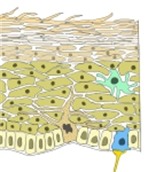
Layers of the epidermis
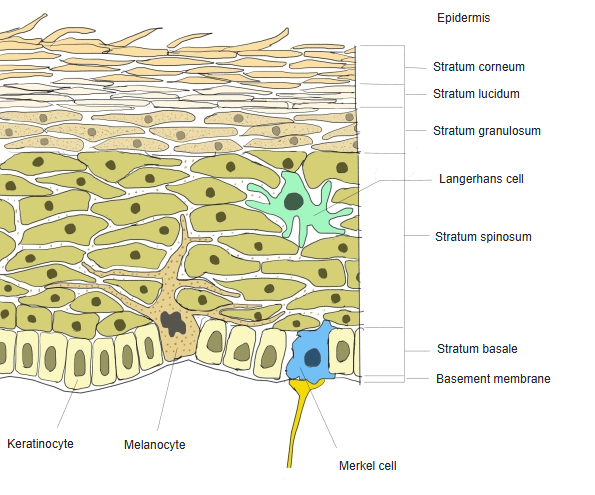
Layers (deep to superficial)
| Layer | Features |
|---|---|
| Stratum basale | One row of columnar cells on the basement membrane; cell division; melanocytes and Merkel cells |
| Stratum spinosum | Several rows of polygonal cells joined by desmosomes ("spines"); Langerhans cells |
| Stratum granulosum | 2–5 rows of flattened cells with keratohyalin granules |
| Stratum lucidum | Thin clear layer, only in thick skin (palms, soles) |
| Stratum corneum | Many layers of flat, dead, keratin-filled cells; shed from the surface |
Cells
| Cell | Role |
|---|---|
| Keratinocytes | The main cells; produce keratin and form the barrier |
| Melanocytes | In the stratum basale; make melanin and pass it to keratinocytes (protection against UV light) |
| Langerhans cells | Dendritic immune cells, mainly in the stratum spinosum |
| Merkel cells | In the stratum basale; with nerve endings form touch receptors (Merkel discs) |
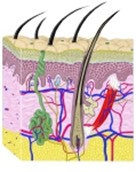
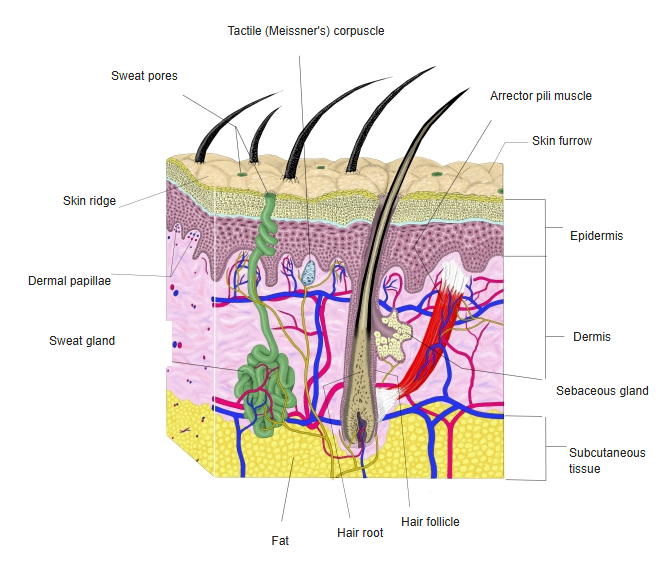
Skin, block diagram
References and sources
- Further reading: Epidermis, Wikipedia.