Latin: ungues
Overview
- Hard, slightly curved plates of keratin on the dorsal surface of the tips of the fingers and toes.
- They protect the fingertip, support the pulp for fine touch and help to pick up small objects.
- Fingernails grow about 3 mm a month; toenails much more slowly.
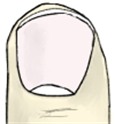
Nail, dorsal view 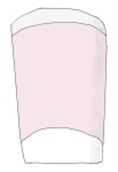
Nail plate, margins
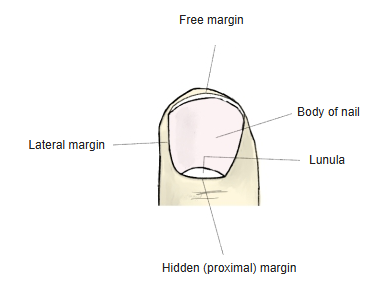
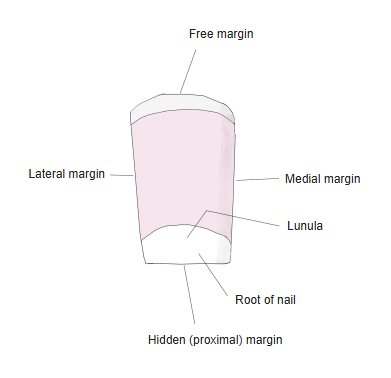
Parts of the nail
| Part | Description |
|---|---|
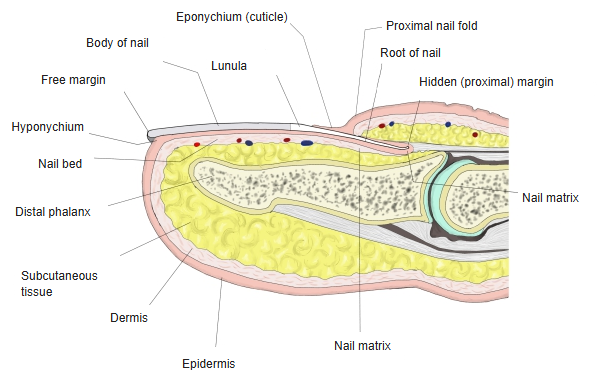
| Body of nail (nail plate) | The visible part; pink because the vessels of the nail bed show through |
| Free margin | The front edge beyond the fingertip |
| Root of nail | The hidden proximal part under the proximal nail fold; its edge is the hidden (proximal) margin |
| Lateral margins | Sides of the plate, set in the lateral nail folds |
| Lunula | Whitish half-moon at the base, the visible front of the nail matrix |
Surrounding tissues
| Structure | Description |
|---|---|
| Nail matrix | Epithelium under the root and lunula that produces the nail plate; damage here deforms the nail |
| Nail bed | Epidermis and dermis under the nail body; the plate slides forward over it |
| Nail folds and nail wall | Skin folds framing the plate proximally and laterally |
| Eponychium (cuticle) | Thin layer of stratum corneum from the proximal nail fold onto the plate |
| Hyponychium | Thickened epidermis under the free margin |
- The distal phalanx lies directly under the nail bed, separated by only a thin layer of dermis.
Fingertip, longitudinal section
References and sources
- Further reading: Nails, Wikipedia.