Latin: musculus longissimus thoracis
Overview
- The thoracic part of the longissimus, one of the three columns of the erector spinae (iliocostalis, longissimus, spinalis).
- The longissimus has three parts — capitis, cervicis and thoracis; the thoracic part is the lowest and the largest.
- It lies medial to the iliocostalis and lateral to the semispinalis; in the lumbar region it is blended with the iliocostalis lumborum.
- It inserts by two rows of slips: a medial row into the vertebrae and a lateral row into the ribs.
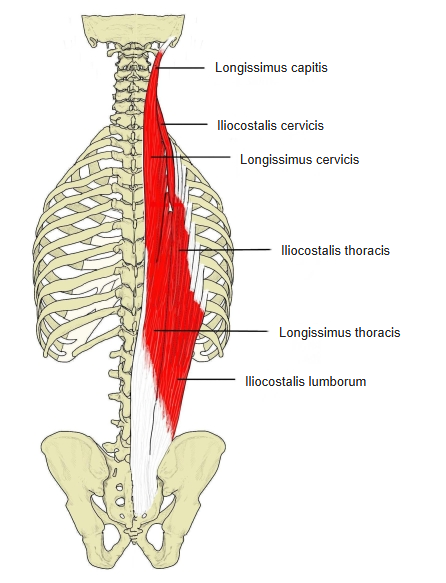
Position in the classification
Trunk › Back › Deep back muscles › Second layer › Intrinsic back muscles › Erector spinae
Illustrations
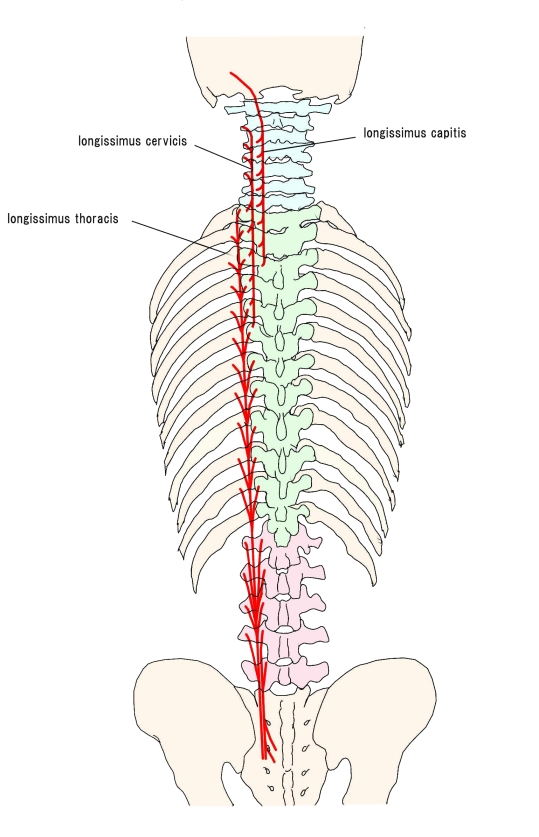
Origin / insertion
- Origin: together with the iliocostalis lumborum, by a strong tendinous sheet from the lumbar spinous processes, the sacrum, the posterior part of the iliac crest and the posterior sacroiliac ligaments
- Accessory medial slips come from the transverse processes of the lower six thoracic vertebrae and the mammillary processes of the upper two lumbar vertebrae.
- Insertion, medial row: transverse processes of all thoracic vertebrae and the accessory processes of the upper lumbar vertebrae
- Insertion, lateral row: lower nine or ten ribs, between the tubercles and the angles, and the costal (transverse) processes of the lumbar vertebrae
Sources differ slightly: some give ribs 2–12, just medial to the angles.
Action
- Bilateral: extends the vertebral column (bends it backward)
- Unilateral: bends the vertebral column to the same side
Innervation
- Lateral branches of the posterior (dorsal) rami of the spinal nerves
Blood supply
- Dorsal branches of the posterior intercostal arteries and the lumbar arteries
Related terms
- Longissimus capitis
- Longissimus cervicis
- Iliocostalis thoracis
- Iliocostalis lumborum
- Erector spinae
- Semispinalis
- Transverse process
References and sources
- Further reading: Longissimus, Wikipedia.
- Gray H. Anatomy of the Human Body, 20th ed. (1918), “6a. The Deep Muscles of the Back”, Bartleby.com.