Mental spine (Latin: spina mentalis)
Also called the genial tubercles or the mental spines (superior and inferior)
- Genioglossus spine : the upper pair; origin of the genioglossus (one of the extrinsic muscles of the tongue).
- Geniohyoid spine : the lower pair; origin of the geniohyoid (one of the suprahyoid muscles).
Their form varies from person to person.
The geniohyoid spines are often only a midline ridge or a rough mark, and the genioglossus spines may be fused into one, or absent and replaced by a rough area. Some studies find only the two upper spines in most mandibles; sources differ. A small midline opening (the lingual foramen) or groove often lies just above the genioglossus spines; it marks the line where the two halves of the mandible fused.
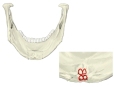 Mental spines (posterior view)
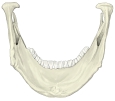 Mandible (posterior view)
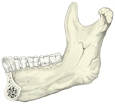 Mandible (medial surface)
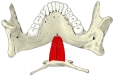 Geniohyoid
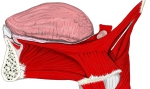 Genioglossus and geniohyoid
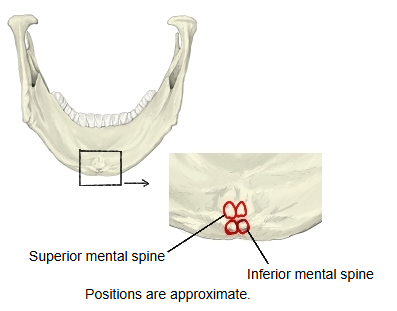
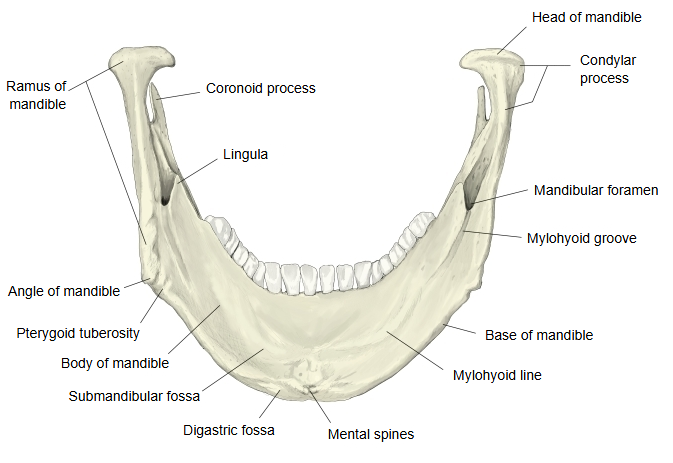
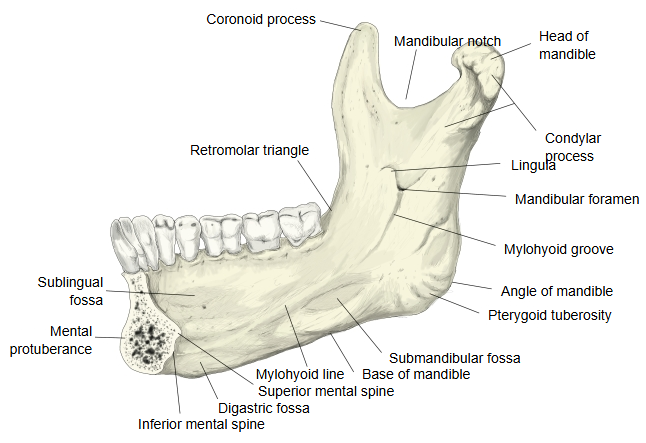
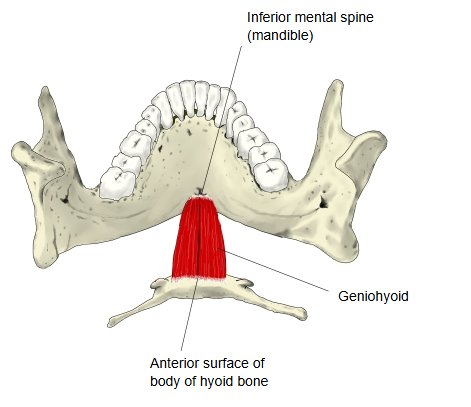
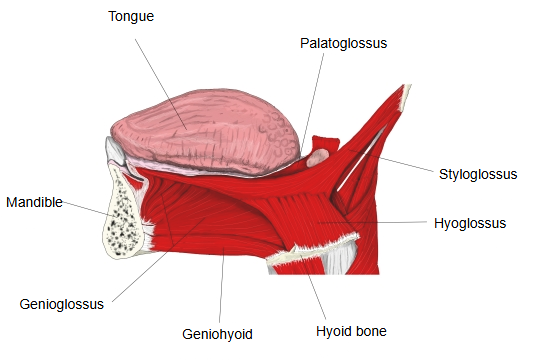
In the usual pattern they form a group of four small, pointed projections in the midline, on the inner side of the mental protuberance. The upper pair is the genioglossus spine and the lower pair the geniohyoid spine; the muscle of the same name arises from each.
Older anatomy textbooks describe them in a similar way.
On the inner surface of the body of the mandible, close to the lower end of the midline, are two pairs of small spines set closely one above the other: the mental spines. The upper, slightly larger pair gives attachment to the genioglossus, the lower pair to the geniohyoid. They are useful landmarks in dental implant and jaw surgery.
Reference websites
[Wikipedia]
· Mental spine, Wikipedia.
[Websites with illustrations]
· The mandible: structure and attachments (TeachMeAnatomy)
· The mandible: anatomy, structure, function (Kenhub)
Related terms
References and sources
- Further reading: Mental spine, Wikipedia.
- Federative International Programme for Anatomical Terminology (FIPAT). Terminologia Anatomica, 2nd ed. (TA2), 2019.