Viscerocranium (Latin: viscerocranium)
Also called the facial skeleton, facial bones or visceral cranium
The viscerocranium is the part of the bones of the head (the skull) that forms the face: the bones of the nose, cheeks, palate and jaws, which also form part of the walls of the orbits. It is also called the visceral cranium or facial skeleton.
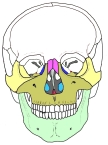 Bones of the face (anterior view)
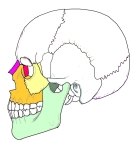 Bones of the face (lateral view)
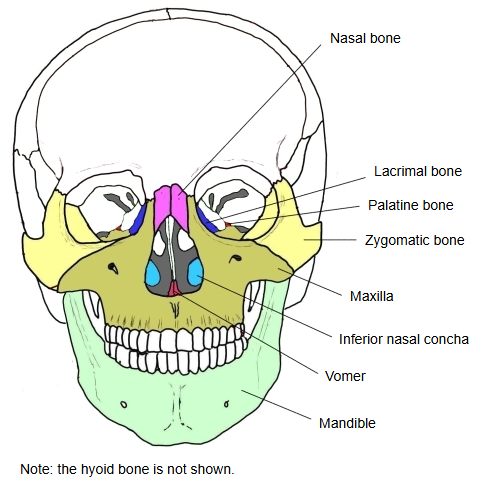
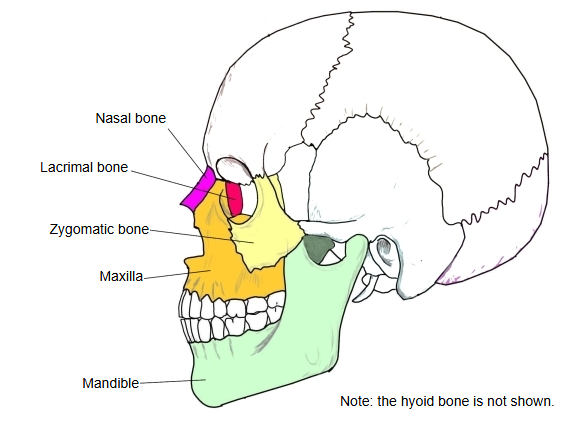
More details
The skull can be divided into two parts: the neurocranium, which holds the brain, and the viscerocranium, which forms the face. In the grouping used here the viscerocranium is made up of 15 bones of 9 kinds.
The viscerocranium surrounds the openings of the nasal cavity and the mouth, so it carries the beginnings of the respiratory and digestive tracts; this is the origin of the name "visceral cranium". Sources differ in the count: many English texts list 14 facial bones and leave out the hyoid bone, and some place the ethmoid bone in the facial skeleton as well.
The grouping below follows one standard anatomy textbook; anatomists differ somewhat in how they divide the bones between the two parts.
(15 kinds, 23 bones)
- Neurocranium (6 kinds, 8 bones)
- Viscerocranium (9 kinds, 15 bones) : also called the visceral cranium
Bones of the viscerocranium
| Viscerocranium (9 kinds, 15 bones) | 1 | Nasal bone | os nasale | paired |
| 2 | Vomer | vomer | unpaired | |
| 3 | Lacrimal bone | os lacrimale | paired | |
| 4 | Inferior nasal concha | concha nasalis inferior | paired | |
| 5 | Maxilla | maxilla | paired | |
| 6 | Zygomatic bone | os zygomaticum | paired | |
| 7 | Palatine bone | os palatinum | paired | |
| 8 | Mandible | mandibula | unpaired | |
| 9 | Hyoid bone | os hyoideum | unpaired |
Related terms
References and sources
- Further reading: Facial skeleton, Wikipedia.
- Further reading: Skull, Wikipedia.
- Federative International Programme for Anatomical Terminology (FIPAT). Terminologia Anatomica, 2nd ed. (TA2), 2019.