Latin: musculus stapedius
Overview
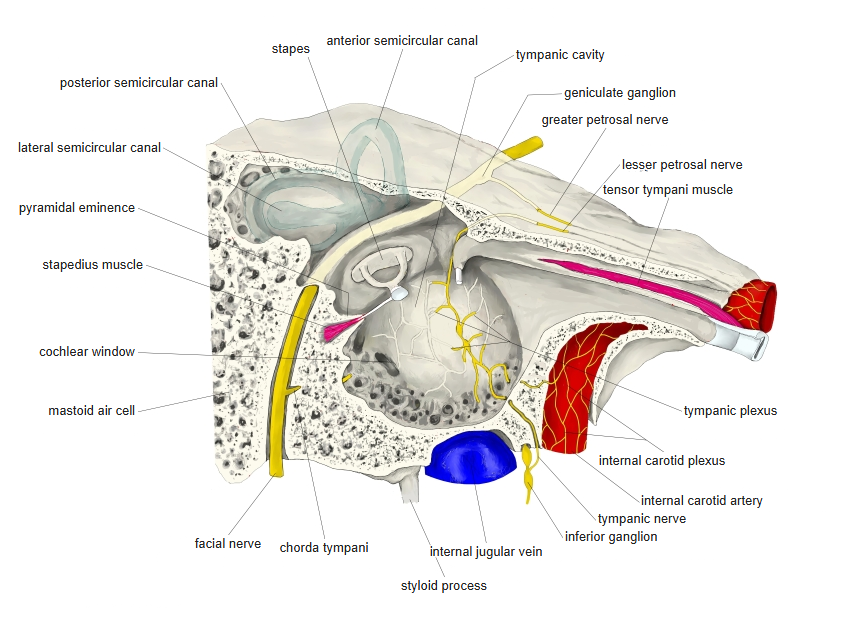
- The smallest skeletal muscle in the human body: a tiny, pyramid-shaped muscle about 1 mm long.
- One of the two muscles of the auditory ossicles in the middle ear, together with the tensor tympani, and the shorter of the two.
- Lies in a bony canal in the posterior wall of the tympanic cavity, inside the pyramidal eminence; only its tendon enters the cavity.
- Shares its developmental origin with the posterior belly of the digastric; found only in mammals.
Position in the classification
Head › Muscles of the auditory ossicles
- Stapedius
- Tensor tympani
Origin
- Inside the pyramidal eminence, a hollow bony projection on the posterior wall of the tympanic cavity
- The tendon emerges through the small opening at the tip of the eminence
Insertion
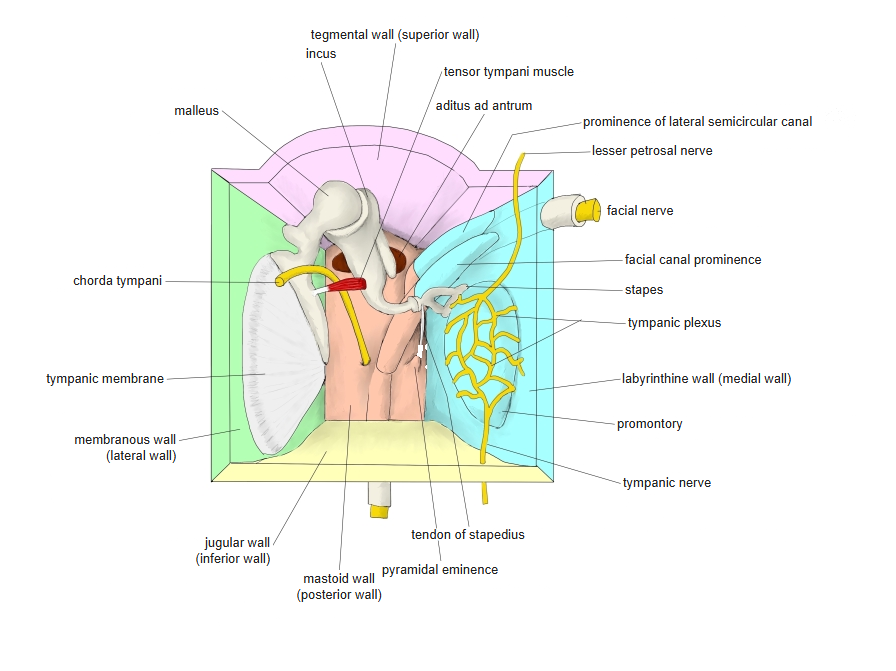
- Neck of the stapes, on the posterior crus close to the head of the stapes
Action
- Pulls the head of the stapes posteriorly, tilting the base of the stapes so that its anterior end moves toward the tympanic cavity
- Dampens the vibration of the stapes and reduces sound transmission to the inner ear
- Takes part in the acoustic reflex, which limits excessive movement of the stapes in response to loud sounds
Innervation
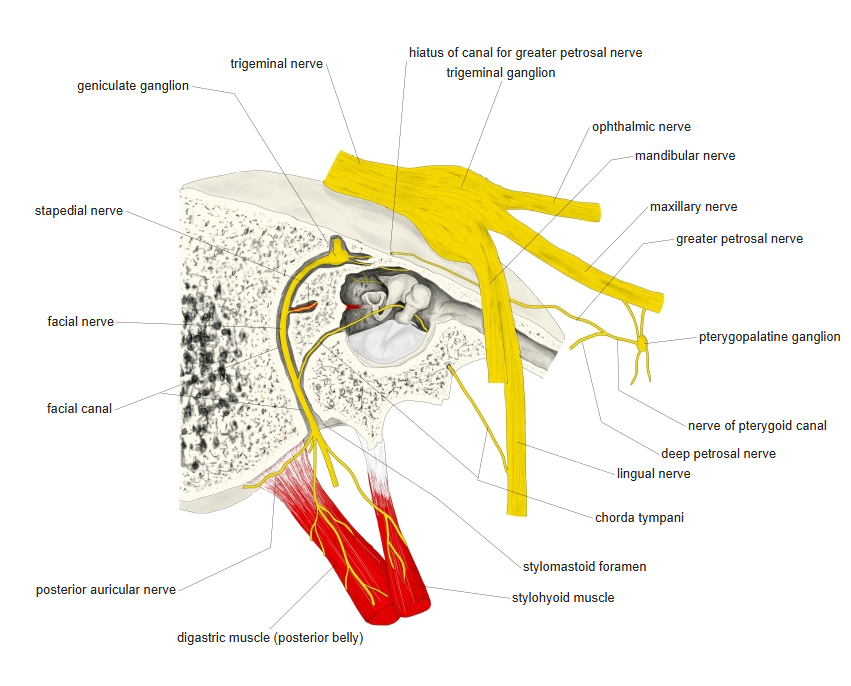
- Nerve to stapedius, a branch of the facial nerve (CN VII)
Blood supply
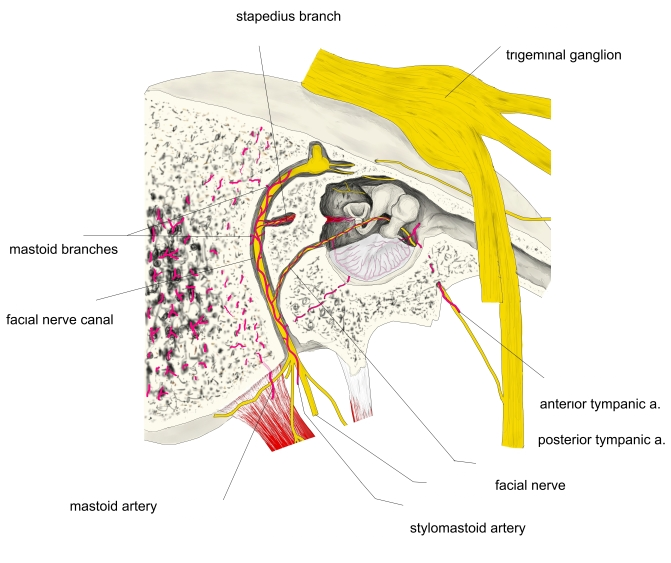
- Stapedial branch of the stylomastoid artery (a branch of the posterior auricular artery)
Related terms
- Stapes
- Tensor tympani
- Auditory ossicles
- Middle ear
- Tympanic cavity
- Pyramidal eminence
- Facial nerve
- Nerve to stapedius
- Stylomastoid artery
- Posterior auricular artery
- Acoustic reflex
References and sources
- Further reading: Stapedius muscle, Wikipedia.