Levator hiatus
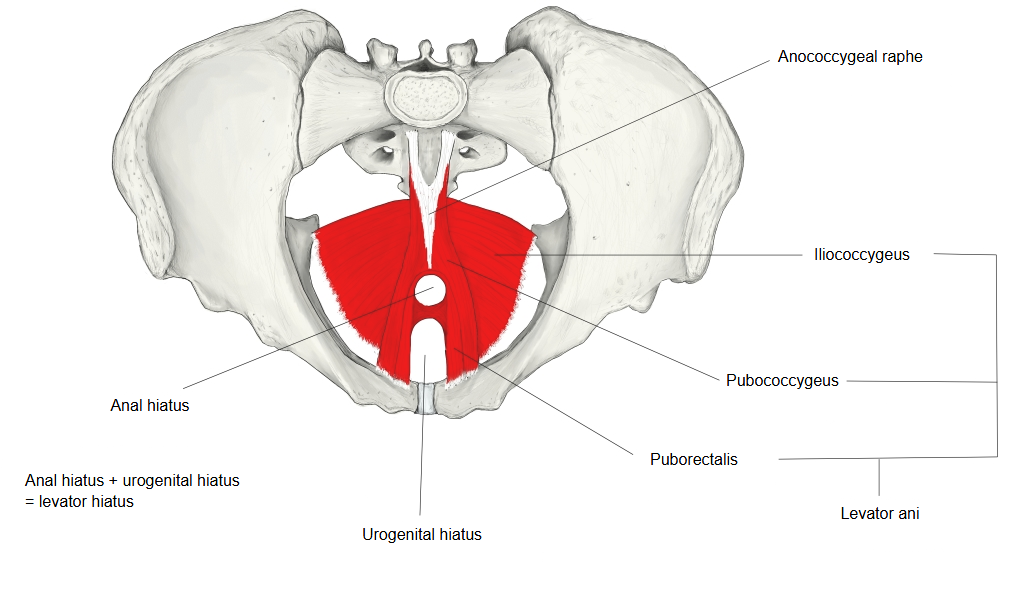
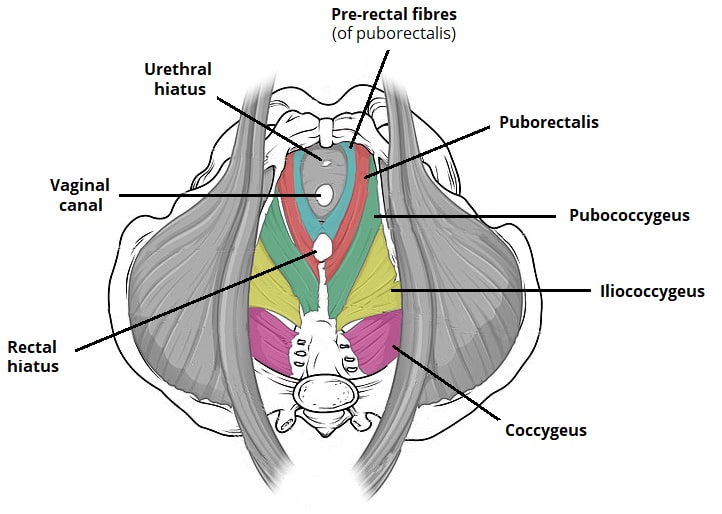
The name is not a term of the official anatomical terminology and is found in only some atlases, but it is widely used in pelvic floor imaging, where the size of the hiatus is measured by ultrasound or MRI. The hiatus lies behind the pubic symphysis, in the front of the pelvic floor between the right and left halves of the levator ani, and is bordered on each side by the medial edges of the pubococcygeus and puborectalis; the urethra, the vagina (in females) and the anorectum pass through it. Some atlases divide it into a front part, the urogenital hiatus (for the urethra and vagina), and a back part, the anal hiatus (for the anal canal); others use "levator hiatus" and "urogenital hiatus" for the same gap. A widened hiatus, often after childbirth injury to the levator ani, is linked with pelvic organ prolapse.
Reference websites
[Wikipedia]
· Levator ani, Wikipedia.
[Websites with illustrations]
· Muscles of the pelvic floor (TeachMeAnatomy)
· The pelvic floor muscles (altaviehealth.com)

Related terms
- Levator ani
- Pubococcygeus
- Puborectalis
- Tendinous arch of levator ani
- Parietal pelvic fascia
- Perineal region
- Levator ani nerve
References and sources
- Further reading: Levator ani, Wikipedia.
- Federative International Programme for Anatomical Terminology (FIPAT). Terminologia Anatomica, 2nd ed. (TA2), 2019.