Posterior limb of stapes (Latin: crus posterius stapedis)
Also called Posterior crus of stapes
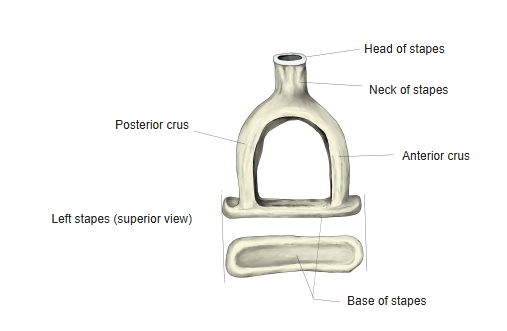
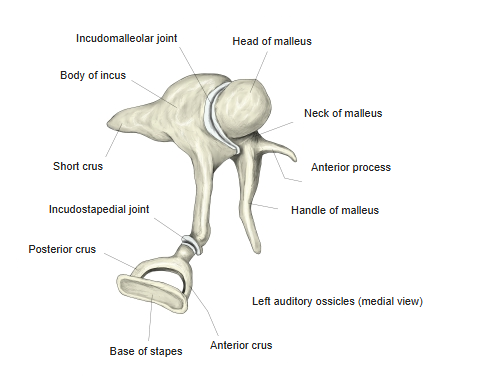
The posterior limb is the back one of the two limbs of the stapes; it is longer and more curved than the anterior limb.
Stapes: one of the auditory ossicles in the tympanic cavityIt runs from the neck of the bone to the back end of its base (footplate).
· The posterior limb is slightly arched, more so than the anterior limb.
· The two limbs diverge from the neck below the head of the stapes and join the oval base, giving the bone its stirrup shape. The base sits in the oval window of the tympanic cavity, so vibrations passing along the limbs reach the inner ear.
Stapes
- Head of stapes : has a facet that articulates with the lenticular process of the incus ⇒ incudostapedial joint.
- Anterior limb / Posterior limb : the anterior limb is shorter and less curved than the posterior limb. The stapedial membrane stretches between their facing edges.
- Base of stapes : a flat, oval plate that fits into the oval window; the annular ligament of the stapes closes the gap around it.
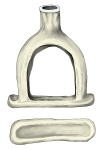 Stapes
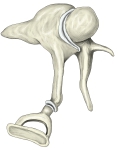 Auditory ossicles (medial view)
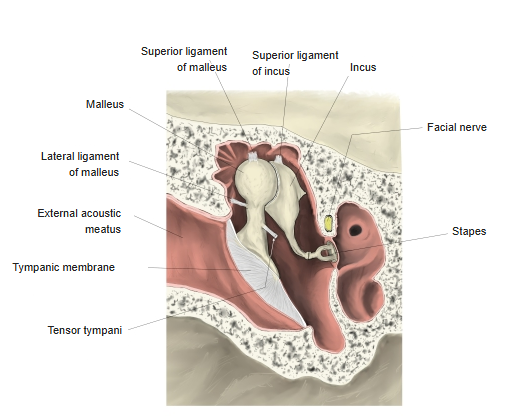
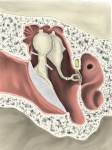 Left tympanic cavity (anterior view)
Reference websites
[Wikipedia]
· Stapes, Wikipedia.
[Websites with illustrations]
· Stapes, front view and view from below (Gray's Anatomy, fig. 918) (Wikimedia Commons)

· Auditory ossicles (labelled) (Wikimedia Commons)

Related terms
References and sources
- Further reading: Stapes, Wikipedia.
- Federative International Programme for Anatomical Terminology (FIPAT). Terminologia Anatomica, 2nd ed. (TA2), 2019.