Latin: stapes (stirrup)
Overview
- The innermost of the three auditory ossicles and the smallest and lightest bone in the body (about 3 mm high); its name means stirrup.
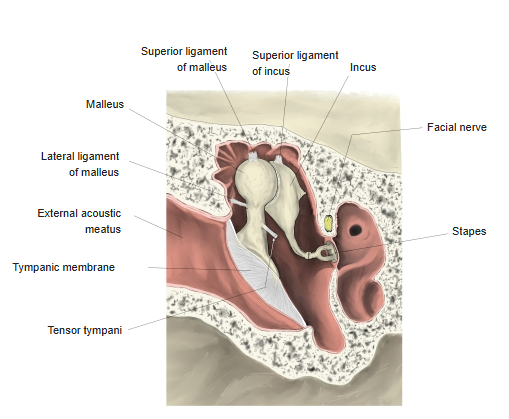
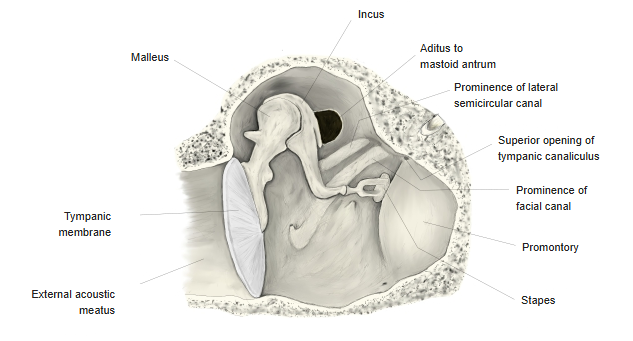
- Its head articulates with the lenticular process of the incus, and its base (footplate) fills the oval window (vestibular window), held there by the annular ligament. Movements of the base pass sound vibrations into the perilymph of the inner ear.
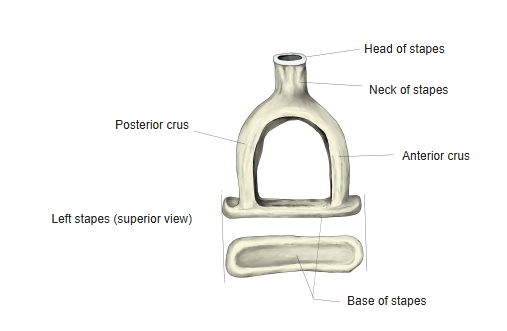
- Its parts are the head, the neck, the anterior and posterior crura and the base.
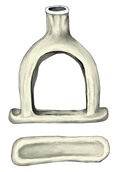
Left stapes
- Bones of the skull
- Neurocranium (cranial bones)
- Frontal bone
- Parietal bone (2)
- Occipital bone
- Temporal bone (2)
- Sphenoid bone
- Ethmoid bone
- Viscerocranium (facial bones)
- Nasal bone (2)
- Vomer
- Lacrimal bone (2)
- Inferior nasal concha (2)
- Maxilla (2)
- Zygomatic bone (2)
- Palatine bone (2)
- Mandible
- Hyoid bone
- Neurocranium (cranial bones)
Illustrations
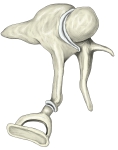
Auditory ossicles (medial view) 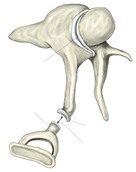
Incudostapedial joint
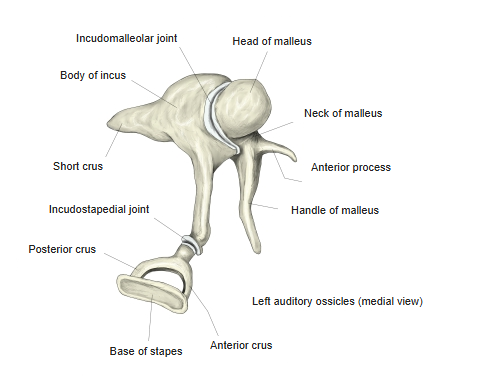
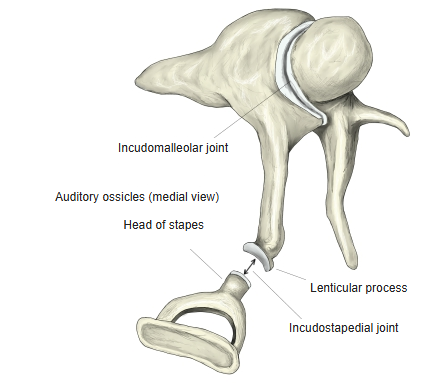
Articulations
| # | Bone | Joint |
|---|---|---|
| 1 | Incus | Incudostapedial joint (head of stapes – lenticular process of incus) |
| 2 | Oval window | Tympanostapedial syndesmosis (base of stapes – margin of the oval window, through the annular ligament) |
-
Incudostapedial joint
Ligaments
The following ligaments attach to the stapes. The list is intended to be comprehensive but may omit minor ligaments.
| # | Ligament | Connects |
|---|---|---|
| 1 | Annular ligament of stapes | Margin of the base – rim of the oval window |
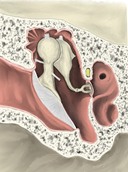
Ligaments of the ossicles 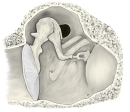
Tympanic cavity (medial view)
Muscle attachments
- Origin of: none
- Insertion of: Stapedius
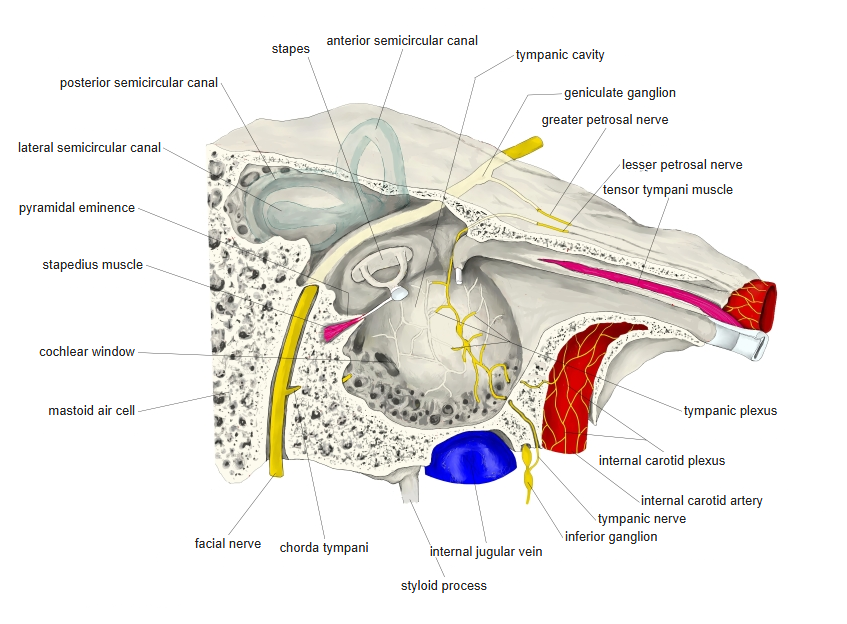
Stapedius arises inside the pyramidal eminence and inserts on the posterior surface of the neck of the stapes; it tilts the base and damps loud sounds (acoustic reflex).
Stapedius muscle (right ear, lateral view)
Parts
- Head – the small knob that articulates with the lenticular process of the incus.
- Neck – the short narrowing below the head; the tendon of the stapedius attaches to its posterior surface.
- Anterior crus and posterior crus – the two limbs that run from the neck to the base; the anterior crus is shorter and straighter than the posterior crus.
- Base (footplate) – the oval plate that sits in the oval window and is joined to its margin by the annular ligament.
References and sources
- Further reading: Stapes, Wikipedia.