Posterior cranial fossa (Latin: fossa cranii posterior)
The rearmost of the three cranial fossae, and the deepest.
- Anterior cranial fossa
- Middle cranial fossa
- Posterior cranial fossa : the deepest.
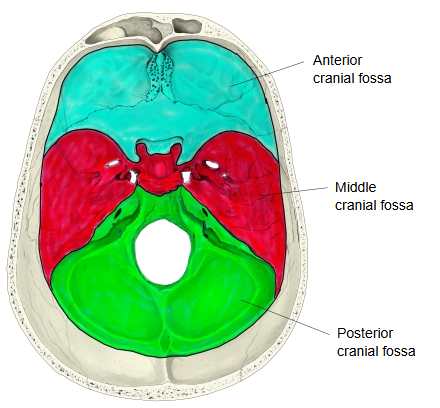
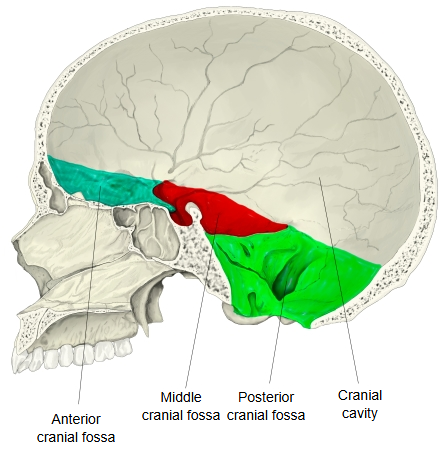
The floor of the cranial cavity descends in three steps from front to back: the anterior, middle and posterior cranial fossae. Each fossa lies lower (deeper) than the one in front of it.
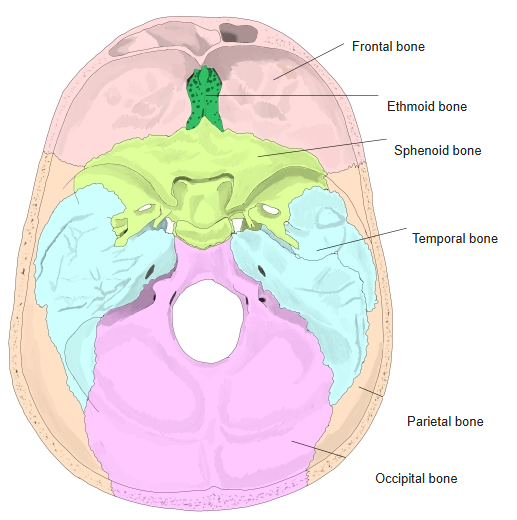
The posterior cranial fossa is formed mainly by the occipital bone, with parts of the temporal bone (the back of the petrous part), the sphenoid (the dorsum sellae) and the parietal bone.
In front it is bounded by the dorsum sellae and the upper borders of the petrous parts; behind, by the groove for the transverse sinus.
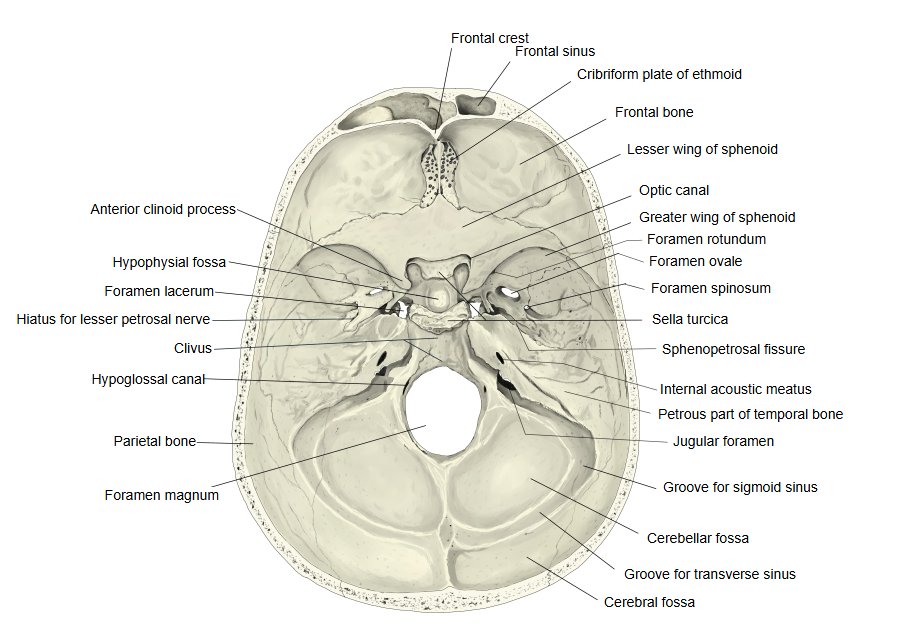
It holds the cerebellum, pons and medulla oblongata. The foramen magnum lies in its centre, with the clivus in front of it; the hollows for the cerebellar hemispheres are the cerebellar fossae.
Other openings include the internal acoustic meatus, the jugular foramen and the hypoglossal canal.
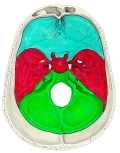 Cranial fossae (superior view)
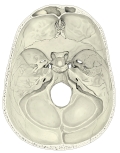 Internal surface of the cranial base
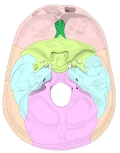 Internal surface of the cranial base (bones colour-coded)
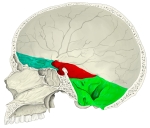 Cranial fossae (lateral view)
Related terms
- Occipital bone
- Foramen magnum
- Clivus
- Cerebellar fossa
- Jugular foramen
- Internal acoustic meatus
- Petrous part
References and sources
- Further reading: Posterior cranial fossa, Wikipedia.
- Federative International Programme for Anatomical Terminology (FIPAT). Terminologia Anatomica, 2nd ed. (TA2), 2019.