Interradicular septa (Latin: septa interradicularia)
Also called Interradicular septum (singular)
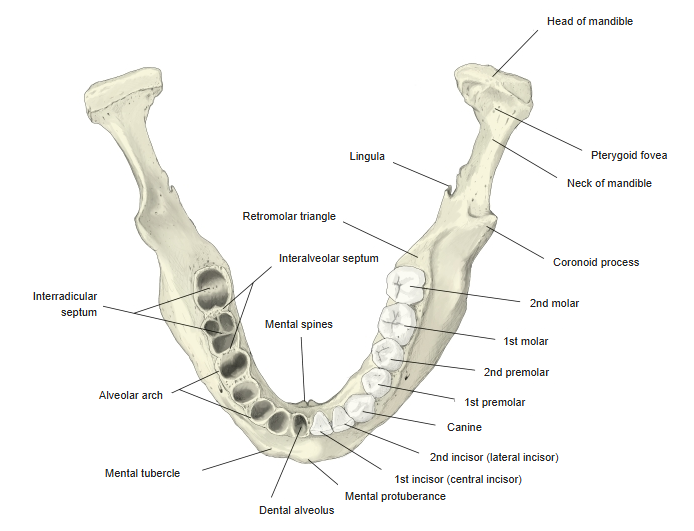
Interradicular septa are the bony walls that separate the roots of a tooth from one another, inside the dental alveolus of a molar.
Molars: teeth with more than one rootDental alveolus: the socket in which the root of a tooth is set
They are found in the sockets of teeth with more than one root, mainly the molars (and the two-rooted upper first premolar), so that each root sits in its own compartment of the socket. They are part of the alveolar process of the maxilla and the alveolar part of the mandible. The periodontal ligament attaches the roots to these septa (its interradicular fibres). Do not confuse them with the interalveolar septa, which separate the sockets of neighbouring teeth.
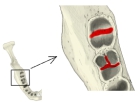 Interradicular septa
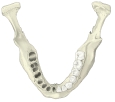 Mandible (from above)
Reference websites
[Wikipedia]
· Dental alveolus, Wikipedia.
[Websites with illustrations]
· The maxilla: landmarks and articulations (TeachMeAnatomy)
· Maxilla: anatomy, function and clinical notes (Kenhub)
Related terms
References and sources
- Further reading: Dental alveolus, Wikipedia.
- Federative International Programme for Anatomical Terminology (FIPAT). Terminologia Anatomica, 2nd ed. (TA2), 2019.