Internal urethral sphincter (Latin: musculus sphincter urethrae internus)
Also called: vesical sphincter; preprostatic sphincter (in males)
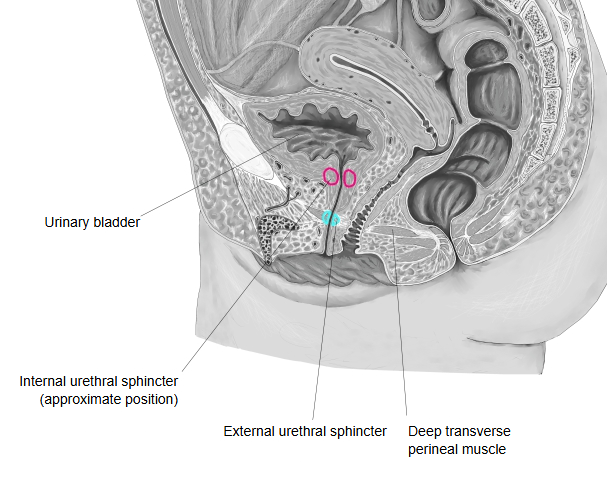
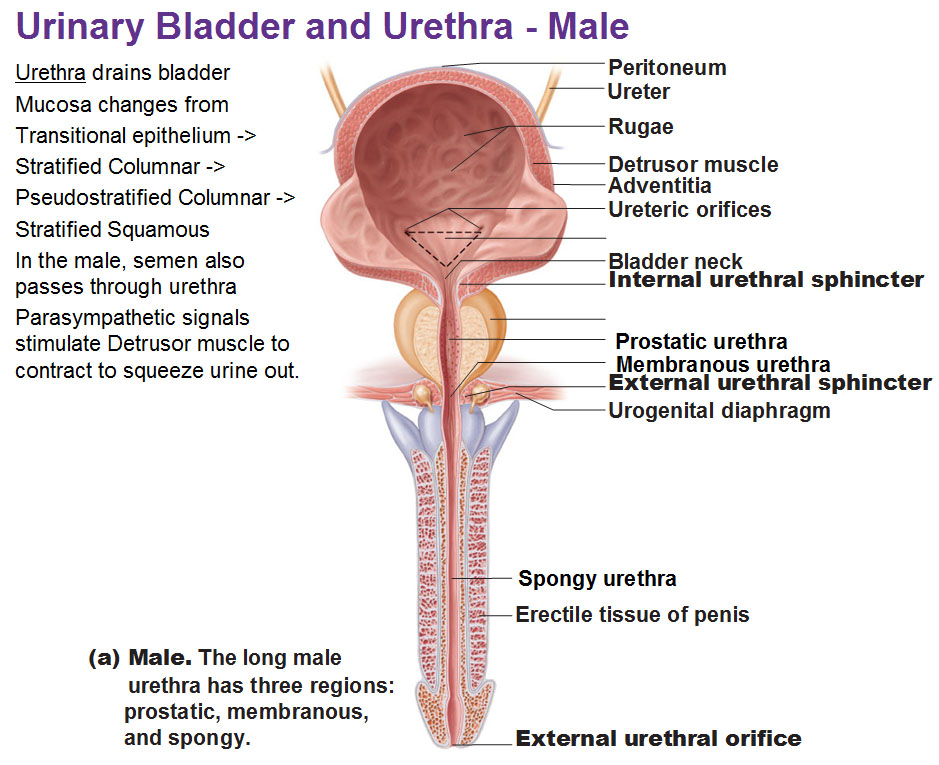
The urethra has two sphincter muscles that control urination: the external urethral sphincter (striated muscle), lower down, where the urethra passes through the urogenital diaphragm (deep perineal pouch) of the pelvic floor, and the internal urethral sphincter (smooth muscle), higher up, at the place where the urinary bladder passes into the urethra (the bladder neck).
sphincters
- Internal urethral sphincter : Position: where the bladder passes into the urethra (the bladder neck). Smooth muscle
- External urethral sphincter : Position: below the internal sphincter, where the urethra passes through the urogenital diaphragm (deep perineal pouch). Striated muscle
The internal urethral sphincter is a ring of smooth muscle around the neck of the bladder at the internal urethral orifice. Being smooth muscle, it is involuntary. Sympathetic fibres (from the lower thoracic and upper lumbar segments, via the hypogastric nerves and the inferior hypogastric plexus) keep it contracted. During urination the parasympathetic pelvic splanchnic nerves (S2–S4) contract the bladder wall while the bladder neck opens. In males it is well developed, lying above the prostate, and closes the bladder neck during ejaculation, so that semen does not flow back into the bladder. Sources differ about females: the smooth muscle at the bladder neck is thin and poorly defined, and many authors do not describe a true internal sphincter there.
Reference websites
[Wikipedia]
· Internal urethral sphincter, Wikipedia.
[Websites with illustrations]
· Male urinary bladder and urethra (antranik.org)
Related terms
- Urinary bladder
- Urethra
- External urethral sphincter
- Sphincter muscle
- Inferior hypogastric plexus
- Prostate
References and sources
- Further reading: Internal urethral sphincter, Wikipedia.
- Federative International Programme for Anatomical Terminology (FIPAT). Terminologia Anatomica, 2nd ed. (TA2), 2019.