Striated muscle (Latin: textus muscularis striatus)
A type of muscle in our body, muscle tissue whose fibres show regular cross-stripes (striations) under the microscope. The name comes from these stripes.
- Striated muscle : skeletal muscle, cardiac muscle
- Smooth muscle : visceral muscle
[More detail] Striated muscle is the muscle that makes up skeletal muscle and cardiac muscle, and it forms most of the body's muscle (skeletal muscle alone is about 40% of body weight; some sources give more). Under the microscope the proteins actin and myosin are seen laid out in a regular pattern that looks like stripes, hence the name. Except for cardiac muscle, which is an involuntary muscle, it can be moved at will: it is a voluntary muscle. The third kind of muscle tissue, smooth muscle, has no stripes.
· Skeletal muscle: voluntary, controlled by motor nerves, each fibre with a motor end plate. Its fibres are long cylinders (several centimetres or more) with many nuclei at the edge, grouped into fascicles. Besides the muscles that move the skeleton, it is found in some viscera, such as the tongue, the pharynx and the upper esophagus. The stripes come from the repeating units of actin and myosin, the sarcomeres.
· Cardiac muscle: involuntary; it forms the wall of the heart (myocardium). Its cells are short and branched, with one or two central nuclei, and are joined end to end by intercalated discs. It is rich in mitochondria, and its sarcomeres are slightly shorter than those of skeletal muscle.
⇒ Micrograph of striated (skeletal) muscle I
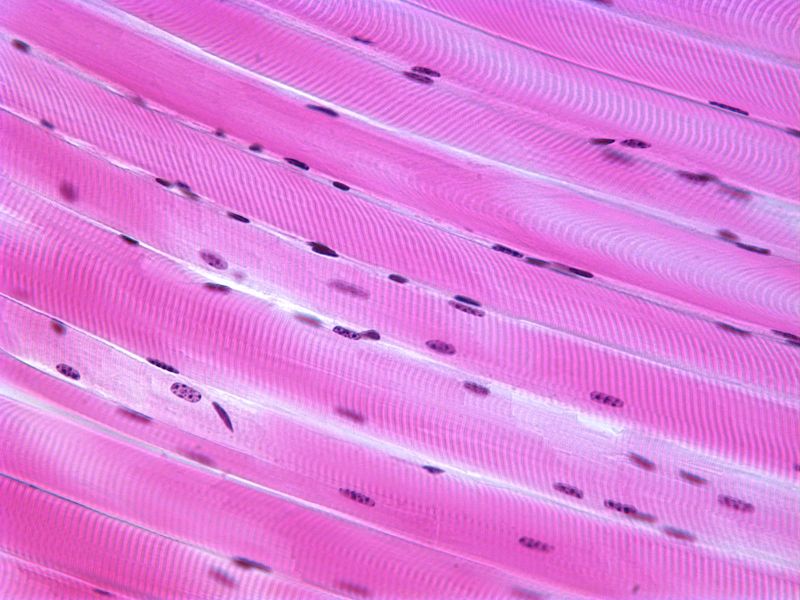
⇒ Micrograph of striated (skeletal) muscle II

| Skeletal muscle (striated) | Smooth muscle | Cardiac muscle (striated) | ||
| 1 | Motor end plate | present | absent | absent |
| 2 | Fibres | cylindrical, long (up to about 15 cm) | spindle-shaped, short (up to about 0.2 mm) | branched |
| 3 | Mitochondria | moderate to many (most in red, slow fibres) | few | very many |
| 4 | Nuclei per fibre | many (at the edge of the fibre) | 1 | 1 (sometimes 2) |
| 5 | Sarcomeres | present, length up to 3.65 µm | absent | present, length up to 2.6 µm |
Related terms
References and sources
- Further reading: Striated muscle tissue, Wikipedia.
- Federative International Programme for Anatomical Terminology (FIPAT). Terminologia Anatomica, 2nd ed. (TA2), 2019.