Squamous suture (Latin: Sutura squamosa)
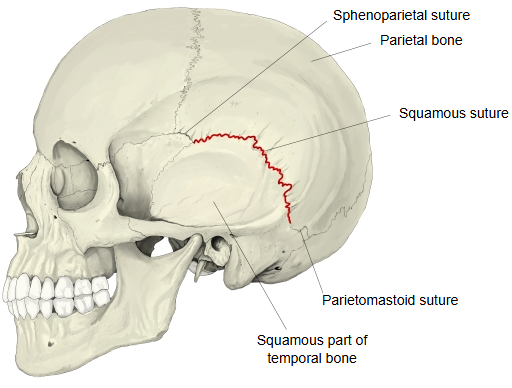
The term squamous suture is used in two ways.
(1) One of the sutures of the skull
The curved suture on the side of the skull between the parietal bone and the squamous part of the temporal bone. It runs in an arch along the upper border of the temporal squama; in front it meets the sphenoparietal suture and behind it continues as the parietomastoid suture.
(2) A type of suture by shape
The sutures of the skull can be grouped by the shape of the bone edges into three types; the squamous suture is one of them.
shape
- Serrate suture : saw-toothed edges that interlock.
- Squamous suture : bevelled edges that overlap like scales.
- Plane suture : straight, smooth edges that meet end to end.
How the edges meet
In a squamous suture the two bone edges are bevelled and overlap, like scales or the edge of a single-edged blade, so that a broad sloping surface of one bone lies on the other. At the named squamous suture the thin edge of the temporal squama overlaps the outer surface of the lower border of the parietal bone (squamosal border).
Related terms
- Lambdoid suture
- Lambdoid border of occipital bone
- Squamosal border
- Suture
- Squamous part
- Coronal suture
- Occipitomastoid suture
- Parietal bone
- Temporal bone
References and sources
- Further reading: Squamous suture, Wikipedia.
- Further reading: Suture (anatomy), Wikipedia.
- Federative International Programme for Anatomical Terminology (FIPAT). Terminologia Anatomica, 2nd ed. (TA2), 2019.