Fibrous layer of periosteum (Latin: stratum fibrosum periostei)
Also called the stratum fibrosum or the outer layer of the periosteum
The fibrous layer of the periosteum is
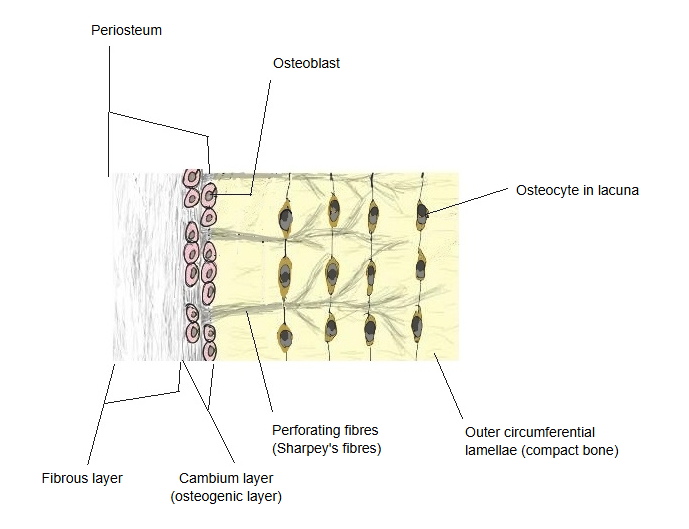
· It is a fibrous outer layer of interwoven bundles of connective tissue (mainly collagen fibres) and elastic fibres, with fibroblasts and few bone-forming cells.
· The inner layer is called the cambium layer (osteogenic layer), cell layer and other names; it lies on the bone and forms new bone.
· Blood vessels run in both layers, but the larger ones lie in the fibrous layer. It is also rich in sensory nerves, so injuries to the periosteum are painful.
· Bundles of collagen (perforating fibres, or Sharpey's fibres) pass from it into the outer bone, anchoring the periosteum and the tendons and ligaments that blend with it.
· The same name (stratum fibrosum) is also used for the outer fibrous layer of a joint capsule.
- Fibrous layer (outer layer) : stratum fibrosum: made of bundles of connective tissue and elastic fibres.
- Cambium layer (inner layer) : stratum osteogenicum: contains osteoblasts; also called the cell layer or proliferative layer.
Reference websites
[Wikipedia]
· Periosteum, Wikipedia.
[Websites with illustrations]
· Periosteum and endosteum (Wikimedia Commons)

Related terms
- Fibrous connective tissue
- Fibrofatty tissue
- Periosteum
- Cambium layer
- Endosteum
- Perichondrium
- Bone matrix
- Diaphysis
- Tendon
References and sources
- Further reading: Periosteum, Wikipedia.
- Federative International Programme for Anatomical Terminology (FIPAT). Terminologia Anatomica, 2nd ed. (TA2), 2019.