Fibrofatty tissue
Also called the fibroadipose tissue
A name that appears on illustrations of the peripheral nerves in anatomy atlases. Few sources explain it in detail, and it is not a formal anatomical term but a descriptive name. Taken literally, it means:
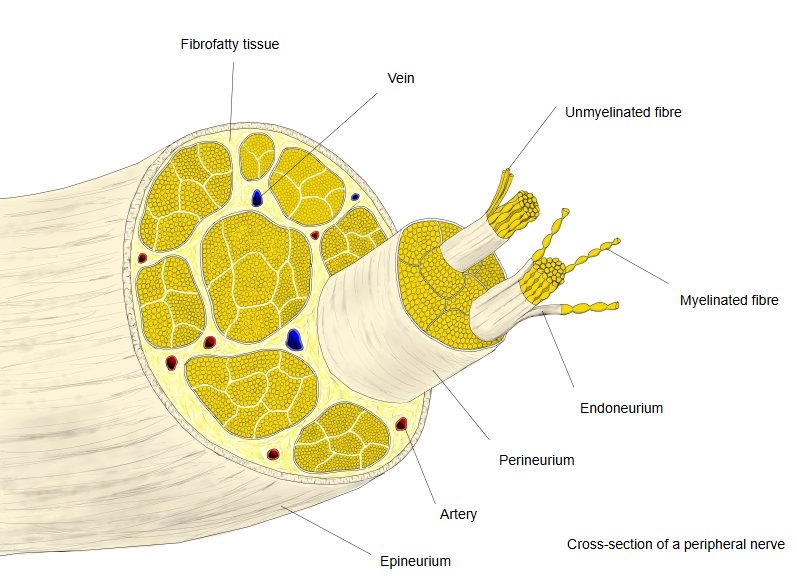
Fibrous connective tissue containing adipose tissue.
A fibrous framework of collagen fibres with groups of fat cells held in it
In a peripheral nerve, the outer sheath (epineurium) and the tissue between the nerve bundles contain such fibrofatty tissue; it cushions the bundles and carries the blood vessels of the nerve. Similar tissue fills spaces around organs and joints, for example in fat pads such as the buccal fat pad, where the fibres give firmness and the fat gives padding. It is softer and more cushioning than dense fibrous tissue such as tendon or fascia.
Related terms
- Fibrous connective tissue
- Fibrous layer of periosteum
- Fascia
- Tendon
- Buccal fat pad
- Orbital fat body
- Perirenal fat capsule
- Interlobular connective tissue
References and sources
- Further reading: Nerve, Wikipedia.
- Further reading: Adipose tissue, Wikipedia.
- Federative International Programme for Anatomical Terminology (FIPAT). Terminologia Anatomica, 2nd ed. (TA2), 2019.