Anterior atlanto-occipital membrane (Latin: membrana atlantooccipitalis anterior)
Question
Sources give two different widths for the anterior atlanto-occipital membrane.
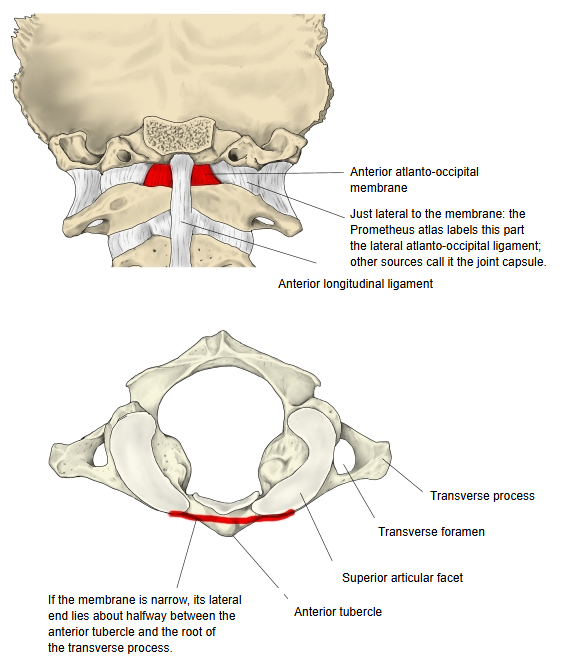
(1) A narrow membrane
If the membrane is narrow, its lateral end probably lies about halfway between the anterior tubercle and the root of the transverse process of the atlas. The part just lateral to it is then labelled either the lateral atlanto-occipital ligament or the articular capsule, depending on the source. The Prometheus atlas (THIEME Atlas of Anatomy) shows a narrow membrane and labels the part lateral to it as the lateral atlanto-occipital ligament.
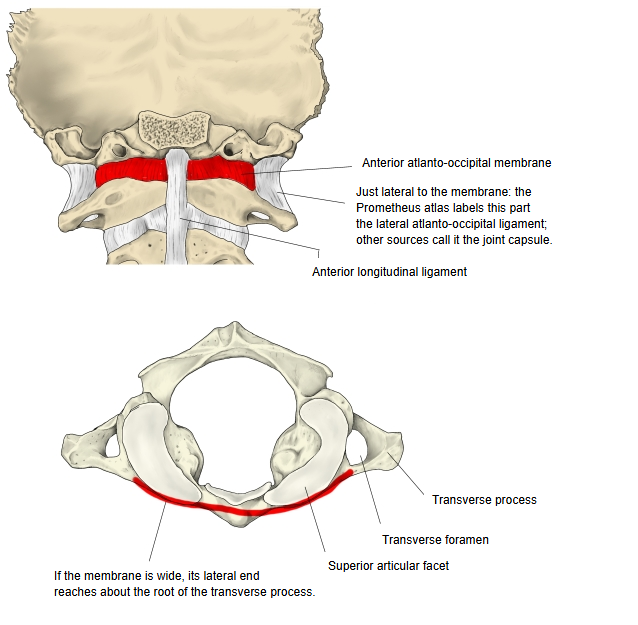
(2) A wide membrane
If the membrane is wide, its lateral end lies at about the root of the transverse process; some anatomy textbooks describe it this way. In that case, seen from the front, the capsule of the atlanto-occipital joint would lie behind the membrane and be hardly visible. The band that joins the occipital bone to the transverse process of the atlas would then be, in the author's view, the lateral atlanto-occipital ligament, but no source has been found to confirm this.
A classic textbook description runs as follows.
The membrane stretches between the anterior arch of the atlas and the front margin of the foramen magnum, and laterally reaches the capsules of the atlanto-occipital joints. It contains elastic fibres, and its middle part is especially thick because fibres of the anterior longitudinal ligament join it. Its continuation between the anterior arch of the atlas and the front of the body of the axis is sometimes called the anterior atlanto-axial membrane (an older term, JNA).
Reference websites
[Wikipedia]
· Anterior atlantooccipital membrane, Wikipedia.
[Websites with illustrations]
· Anterior atlanto-occipital membrane and atlantoaxial ligament (Gray's Anatomy, fig. 304) (Wikimedia Commons)
