Vitreous chamber (Latin: camera vitrea)
Also called the vitreous cavity or the postremal chamber
The vitreous chamber is the space that holds the vitreous body, in the part of the eyeball behind the lens; it takes up about four-fifths of the volume of the eyeball.
Apart from the part where the lens fits in, it is surrounded by the retina
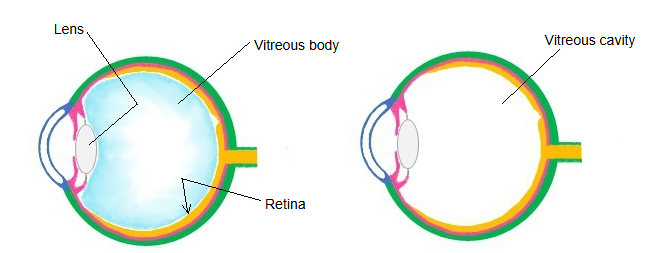
The vitreous chamber is bounded in front by the lens and the ciliary zonule, and elsewhere by the retina and the ciliary body. Its front wall is hollowed out where the back of the lens fits in (the hyaloid fossa). It is one of the three chambers of the eyeball, with the anterior and posterior chambers, which hold aqueous humour.
Related terms
- Vitreous humour
- Vitreous membrane
- Hyaloid fossa
- Zonular spaces
- Vitreous body
- Chambers of eyeball
- Eyeball
- Lens
- Retina
- Posterior chamber of eyeball
- Anterior chamber of eyeball
References and sources
- Further reading: Vitreous chamber, Wikipedia.
- Federative International Programme for Anatomical Terminology (FIPAT). Terminologia Anatomica, 2nd ed. (TA2), 2019.