Ligament (Latin: ligamentum)
More details
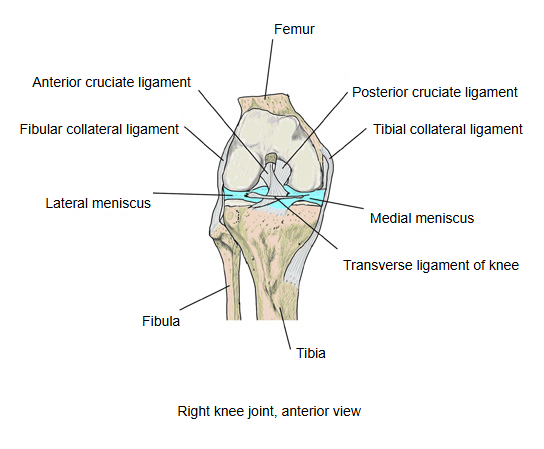
The main component of a ligament is fibrous collagen. Ligaments join bone to bone and keep the joints stable. They are slightly elastic and stretch gradually under tension. The cruciate ligaments of the knee are well-known examples.
· The collagen fibres are packed in parallel, with a few fibroblasts between them, so a ligament resists pulling very well. Some ligaments also contain many elastic fibres and are more stretchy (for example the ligamenta flava of the vertebral column).
· A ligament stabilises a joint and limits movements that would damage it. Under steady load it stretches slowly; a ligament that is overstretched or torn (a sprain) heals slowly because it has a poor blood supply.
· By position, joint ligaments are capsular (thickenings of the fibrous joint capsule), extracapsular (outside the capsule) or intracapsular (inside it, like the cruciate ligaments of the knee).
· The word is also used for other structures: folds of peritoneum that hold organs (peritoneal ligaments) and fibrous cords left from fetal vessels (such as the round ligament of the liver).
· A ligament joins bone to bone; a tendon joins muscle to bone. For the individual ligaments, see Ligaments.
Related terms
- Capsular ligament
- Extracapsular ligament
- Intracapsular ligament
- Accessory ligament
- Tendon
- Joint capsule
- Knee joint
References and sources
- Further reading: Ligament, Wikipedia.
- Federative International Programme for Anatomical Terminology (FIPAT). Terminologia Anatomica, 2nd ed. (TA2), 2019.