Extracapsular ligament (Latin: ligamentum extracapsulare)
Some textbooks divide the accessory ligaments of synovial joints into two groups, intracapsular ligaments and extracapsular ligaments, as follows:
ligaments
- Intracapsular ligaments : ligaments inside the joint capsule. Example: the ligament of the head of the femur.
- Extracapsular ligaments : ligaments outside the joint capsule. Example: the collateral ligaments.
· An extracapsular ligament lies outside the joint capsule, separate from it.
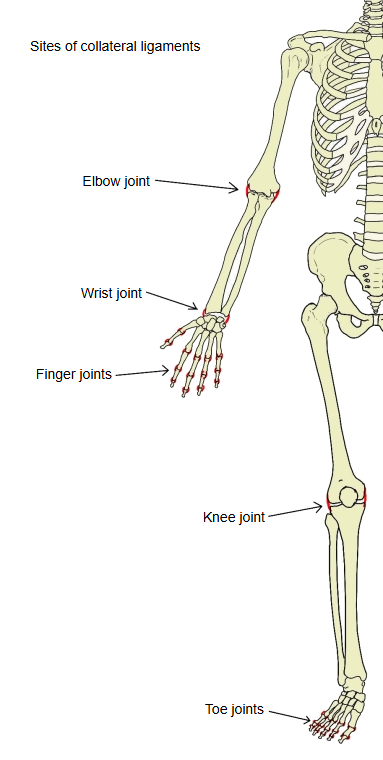
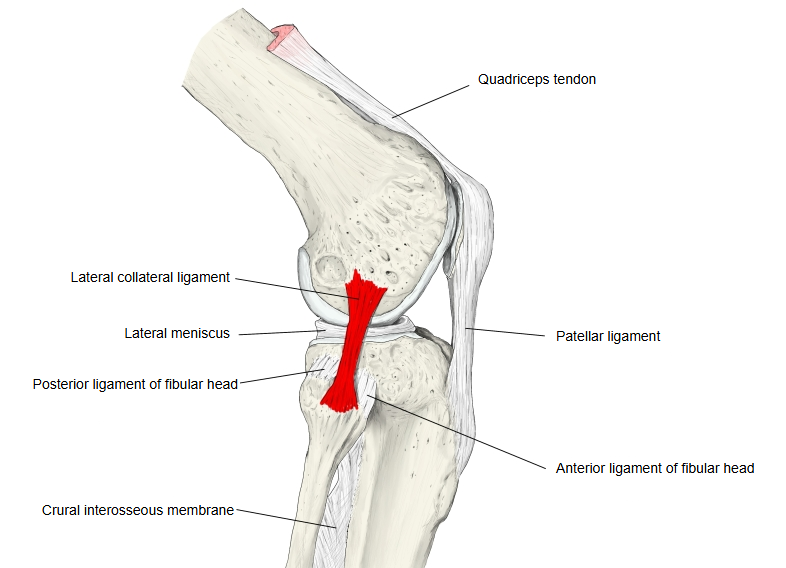
· Most collateral ligaments, which lie on both sides of hinge-like joints, are extracapsular. They are found at the elbow, wrist, knee and the finger and toe joints. A typical example is the fibular collateral ligament of the knee, a cord that stands clear of the capsule and the lateral meniscus.
· Extracapsular ligaments limit movement and keep the bones of the joint in line, especially against sideways forces.
· Sources differ on whether thickened bands that blend with the capsule, such as the tibial collateral ligament, count as extracapsular or as capsular ligaments.
 Sites of the collateral ligaments (whole body, anterior view)
 Right knee joint (lateral view)
Related terms
- Accessory ligament
- Collateral ligaments
- Fibular collateral ligament
- Tibial collateral ligament
- Knee joint
- Synovial membrane
References and sources
- Further reading: Ligament, Wikipedia.
- Further reading: Synovial joint, Wikipedia.
- Federative International Programme for Anatomical Terminology (FIPAT). Terminologia Anatomica, 2nd ed. (TA2), 2019.