Oblong fovea (Latin: fovea oblonga)
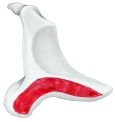 Oblong fovea
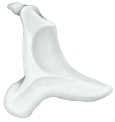 Arytenoid and corniculate cartilages (anterolateral surface)
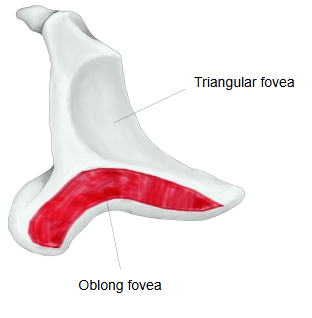
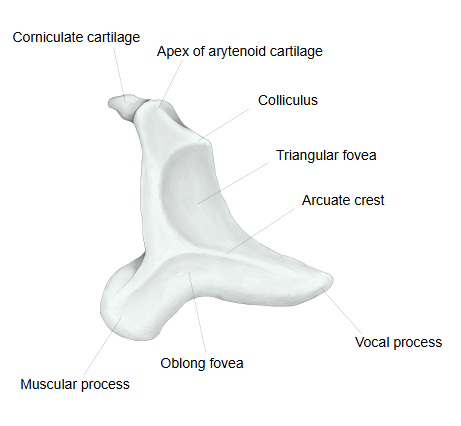
The arytenoid cartilages are a pair of hyaline cartilages that sit on the upper lateral corners of the lamina of the cricoid cartilage. Changes in their position directly alter the shape of the glottis and the tension of the vocal folds, so they are very important for voice production. Each is shaped like a three-sided pyramid with an apex, a base and three surfaces (medial, anterolateral and posterior). The base articulates with the cricoid lamina by an articular surface on its under side and sends out two processes: laterally the short, blunt muscular process, for part of the arytenoid muscle and the lateral and posterior cricoarytenoid muscles; and forwards the small vocal process, which projects into the laryngeal cavity and gives attachment to the vocal ligament, stretched between it and the thyroid cartilage in the midline. The apex bends backwards and medially and joins the corniculate cartilage. The medial surface faces the cavity of the larynx and is smooth. On the anterolateral surface is an arched ridge, the arcuate crest, whose small projection at the upper end is the colliculus. The lowest part of this surface is a depression, the oblong fovea, for the vocalis muscle; above it is another deep pit, the triangular fovea.
A broad, shallow depression on the anterolateral surface, just above the base of the cartilage, between the vocal process in front and the muscular process behind. The arcuate crest separates it from the deeper triangular fovea above. The vocalis is the inner part of the thyroarytenoid muscle, so some sources simply say the thyroarytenoid attaches here; through this attachment the vocalis adjusts the tension of the vocal fold.
Reference websites
[Wikipedia]
· Arytenoid cartilage, Wikipedia.
[Websites with illustrations]
· The larynx (TeachMeAnatomy)
· Larynx (Kenhub)
Related terms
- Arytenoid cartilage
- Arcuate crest of arytenoid cartilage
- Colliculus (arytenoid cartilage)
- Vocal process
- Muscular process of arytenoid cartilage
- Vocal fold
- Larynx
References and sources
- Further reading: Arytenoid cartilage, Wikipedia.
- Federative International Programme for Anatomical Terminology (FIPAT). Terminologia Anatomica, 2nd ed. (TA2), 2019.