Parietal region (Latin: regio parietalis)
The parietal region
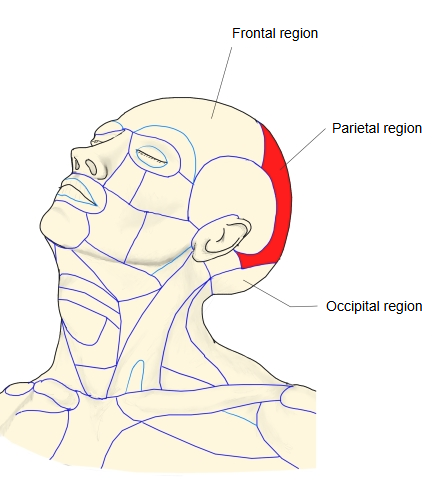
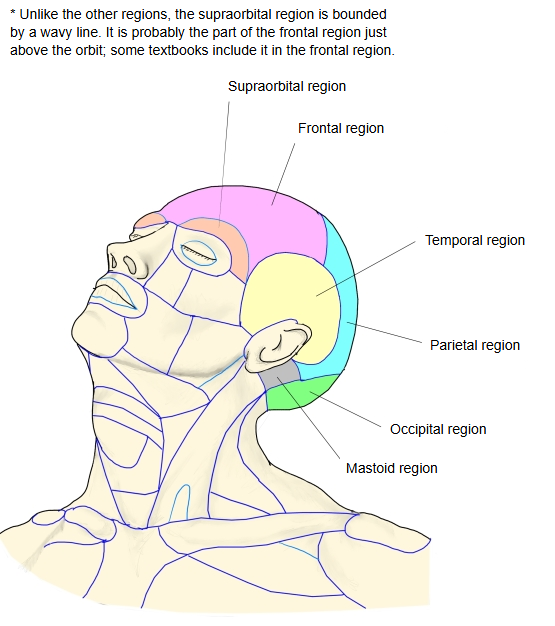
In the anatomical regions of the body, the parietal region is one of the regions of the head: the area at the top of the head, between the frontal region and the occipital region.
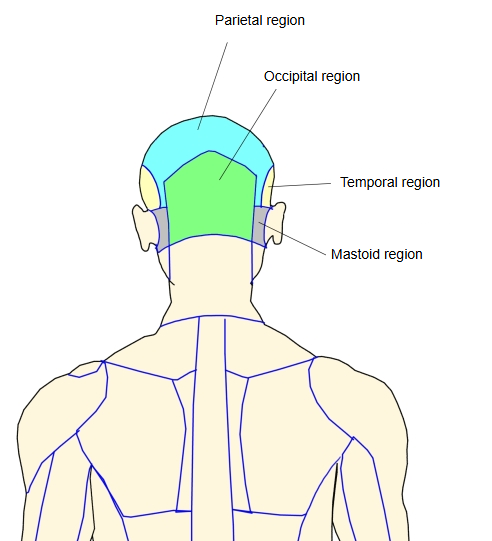
It is the surface region on the top and upper side of the head, overlying the parietal bone and the parietal tuber of the calvaria. It lies behind the frontal region and above the occipital region, with the temporal region on each side below it. Sources differ on its exact borders, so figures drawn from different viewpoints may show it slightly differently.
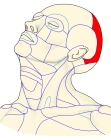 Parietal region (side view)
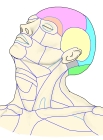 Regions of the head
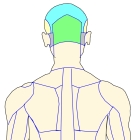 Regions of the head (posterior view)
On this site the body is divided into three main parts, the head and neck, the trunk and the limbs, and the limbs into the upper and lower limbs. Each part is divided further into smaller regions.
Regions
of the
body
of the
body
- Head and neck : 1. head (head, face) 2. neck
- Trunk : 1. chest 2. abdomen 3. back
- Limbs
- Upper limb : 1. shoulder 2. arm 3. elbow 4. forearm 5. hand
- Lower limb : 1. perineum 2. thigh 3. knee 4. leg 5. foot
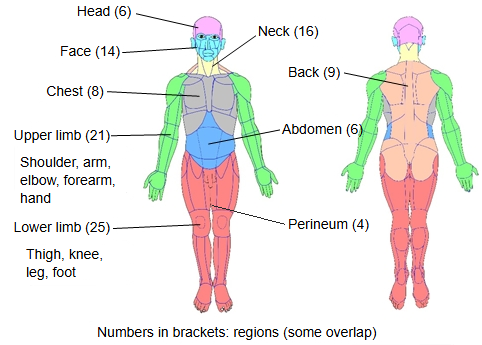
| Head (6) | 1 | Frontal region |
| 2 | Supraorbital region (counted separately in some sources) | |
| 3 | Parietal region | |
| 4 | Occipital region | |
| 5 | Temporal region | |
| 6 | Mastoid region |
Related terms
- Parietal bone
- Frontal region
- Occipital region
- Temporal region
- Supraorbital region
- Calvaria
- Parietal tuber
References and sources
- Further reading: Parietal bone, Wikipedia.
- Further reading: Scalp, Wikipedia.
- Federative International Programme for Anatomical Terminology (FIPAT). Terminologia Anatomica, 2nd ed. (TA2), 2019.