Alveolar cells
Also called the pneumocytes or the alveolar epithelial cells
⇒ See the structure of the alveolar wall on the Pulmonary alveoli page.
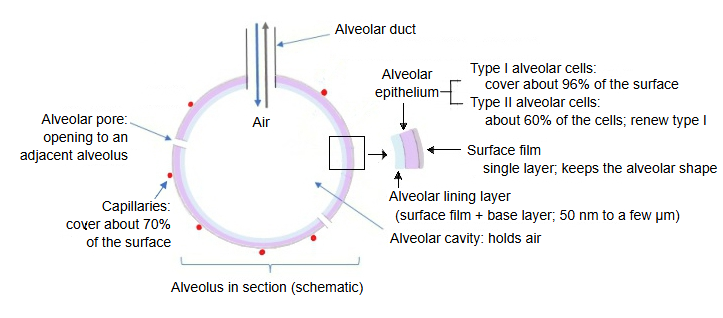
Alveolar cells are the epithelial cells that line the pulmonary alveoli, the tiny air spaces of the lung where gas exchange takes place. Type I alveolar cells (squamous alveolar cells) are very thin, flat cells, in places only about 25 nm thick; they are fewer in number, but each covers a large area, so together they cover more than 95% of the alveolar surface, and gas passes across them to and from the capillaries. Type II alveolar cells (great alveolar cells, granular pneumocytes) are cuboidal cells with short microvilli; they are the more numerous but cover only a small part of the surface. They secrete surfactant and can divide and turn into type I cells to repair the lining. Some texts also describe a rare type III cell (brush cell) with thick microvilli, usually lying beside type II cells; sources differ on whether to count it as a separate type. Neighbouring alveolar cells are sealed to each other by tight junctions, which keep tissue fluid out of the air space. Alveolar macrophages (dust cells) also live on the alveolar surface, but they are wandering phagocytes, not part of the epithelium.
 Alveolus in section (schematic)
Related terms
References and sources
- Further reading: Pulmonary alveolus, Wikipedia.
- Further reading: Pulmonary surfactant, Wikipedia.
- Federative International Programme for Anatomical Terminology (FIPAT). Terminologia Anatomica, 2nd ed. (TA2), 2019.