Anatomical conjugate (Latin: conjugata anatomica)
Also called the true conjugate
It is about 0.5 cm longer than the obstetric conjugate, which runs from the promontory to the nearest point on the back of the symphysis and is the narrowest front-to-back diameter of the inlet.
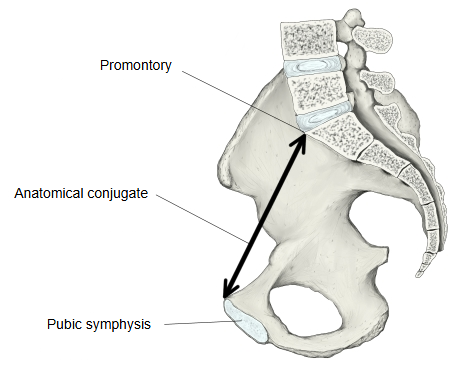
The anatomical conjugate is a front-to-back (longitudinal or median) diameter near the superior pelvic aperture (pelvic inlet, bounded by the pelvic brim), drawn from the midpoint of the promontory to the midpoint of the upper border of the pubic symphysis and measured on the bony pelvis. It is a little longer than the obstetric conjugate, on average about 11.8 cm (adults: about 11 to 12 cm). Sources differ on the names: "true conjugate" is used for the anatomical conjugate by some and for the obstetric conjugate by others.
In a living woman it cannot be measured directly. In practice the inlet is estimated from the diagonal conjugate (from the promontory to the lower border of the symphysis, measured by vaginal examination) or by imaging; see also the external conjugate.
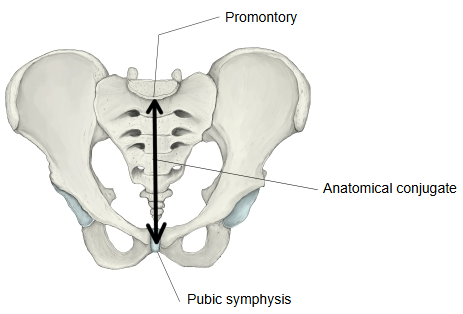 Anatomical conjugate (front view)
 Anatomical conjugate (median section)
Reference websites
· Bony pelvis (figure), SlideShare.

· Obstetric anatomy (figure), SlideShare.

Related terms
- Diagonal conjugate
- External conjugate
- Median diameter (pelvis)
- Promontory (sacrum)
- Pubic symphysis
- Superior pelvic aperture
- Pelvic brim
References and sources
- Further reading: Pelvic inlet, Wikipedia.
- Further reading: Pelvimetry, Wikipedia.
- Federative International Programme for Anatomical Terminology (FIPAT). Terminologia Anatomica, 2nd ed. (TA2), 2019.