Brown adipocyte
Also called the brown fat cell or multilocular adipocyte
One of the fat cells of the body. As its name says, it is brown, and it burns fat to produce heat rather than storing it as an energy reserve.
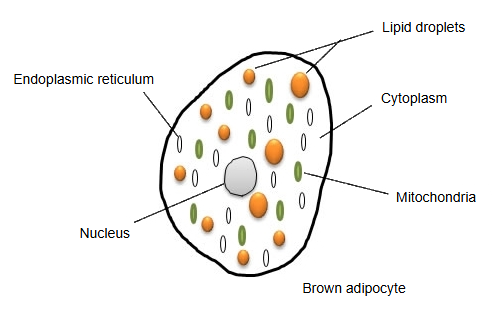
More details
Fat cells store fat as lipid droplets. In the brown adipocyte the fat is held in many small and medium-sized droplets (a multilocular adipocyte), unlike the single large droplet of a white adipocyte.
It has the following features:
1. Relatively few in number
Brown adipocytes are far fewer than white adipocytes.
2. They decrease with growth
Brown fat is most plentiful in the newborn and decreases with age; estimates of how much an adult has vary widely between sources.
3. They are found only in certain places
White adipocytes occur throughout the body, but brown adipocytes are found only in certain places: in the newborn especially between and below the shoulder blades (scapula); in adults small deposits remain at the back of the neck and above the clavicle, in the armpit, along the spine, in the mediastinum around the aorta, and around the kidneys (in the perirenal fat).
Functions
Brown and white adipocytes are both fat cells, but their roles are opposite: the brown adipocyte burns energy, while the white adipocyte stores it.
1. Keeping the body warm
The cell is packed with mitochondria, which give the tissue its brown colour; the tissue is also rich in capillaries and sympathetic nerve fibres.
The mitochondria contain uncoupling protein 1 (thermogenin), which lets them release energy as heat instead of storing it (non-shivering thermogenesis). When the body is exposed to cold, the brown adipocytes become active and raise body temperature to protect the body from the cold.
2. Burning energy
They burn surplus energy taken in with food, and so help to prevent excess fat from building up in the body.
Related terms
References and sources
- Further reading: Brown adipose tissue, Wikipedia.
- Further reading: Adipocyte, Wikipedia.
- Federative International Programme for Anatomical Terminology (FIPAT). Terminologia Anatomica, 2nd ed. (TA2), 2019.