Red blood cell (Latin: Erythrocytus)
Also called the erythrocyte
One of the cells of the blood flowing in our blood vessels, and the most numerous: a small, biconcave disc without a nucleus, filled with hemoglobin. Blood looks red because of the red blood cells.
In more detail
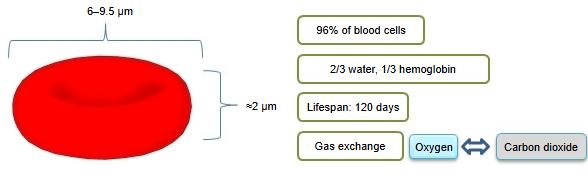
Like the other blood cells (white blood cells and platelets), red blood cells arise from hematopoietic stem cells in the red bone marrow. They make up about 96% of the blood cells (the cellular part of blood). Mature red cells have lost their nucleus and organelles, which leaves more room for hemoglobin. Their main features are:
| 1 | Shape | A disc that is slightly hollowed in the middle (biconcave). It is very flexible and changes shape to pass through even the narrowest capillaries. |
| 2 | Size | About 7-8 µm across (range about 6-9.5 µm) and about 2 µm thick at the rim. 1 µm = 1/1,000,000 m = 1/1000 mm  |
| 3 | Content | About two-thirds water and one-third hemoglobin, with small amounts of enzymes, glucose, carbonic acid and ions such as sodium and calcium. |
| 4 | Number | About 5 million per mm³ in adult men and about 4.5 million per mm³ in adult women; higher in newborns (about 6-7 million per mm³). |
| 5 | Colour | The red comes from hemoglobin. Hemoglobin carrying oxygen is bright red; hemoglobin that has given up its oxygen is darker red (as in venous blood, compared with arterial blood). |
| 6 | Life span | About 120 days. Old cells are removed mainly in the spleen (and liver), and part of their material, especially the iron, is reused to make new red cells. |
| 7 | Function | Transport of the respiratory gases: they carry oxygen taken in by the lungs to the tissues of the whole body, and help carry the carbon dioxide made in the tissues back to the lungs. |
[Development of red blood cells]
Like white blood cells, platelets and the other blood cells, red blood cells develop from hematopoietic stem cells, in the following steps:
| 1 | In the bone marrow | Hematopoietic stem cell | The cell from which all blood cells arise. |
| 2 | Myeloid stem cell | Also called the common myeloid progenitor. | |
| 3 | Burst-forming unit-erythroid (BFU-E) | Early erythroid progenitor. | |
| 4 | Colony-forming unit-erythroid (CFU-E) | Late erythroid progenitor, formed from BFU-E after several divisions. | |
| 5 | Erythroblast | Under the hormone erythropoietin, CFU-E cells divide several times and become erythroblasts, which pass through four stages: (1) proerythroblast, (2) basophilic erythroblast, (3) polychromatic erythroblast (these three can still divide), (4) orthochromatic erythroblast, which pushes its nucleus out of the cell (enucleation) in the bone marrow. | |
| 6 | In the blood vessels | Reticulocyte | Still has a few organelles, which look like a fine network when stained. It stays in the marrow for 1-2 days and then enters the blood. |
| 7 | (Mature) red blood cell | After the reticulocyte enters the blood, it takes another 1-2 days to lose its remaining organelles and become a mature red blood cell. |
Reference websites
[Wikipedia]
· Red blood cell, Wikipedia.
· Erythropoiesis, Wikipedia.
[Websites with illustrations]
· Red blood cell (Encyclopaedia Britannica)
· Red blood cells (scanning electron micrograph) (Wikimedia Commons)

Related terms
References and sources
- Further reading: Red blood cell, Wikipedia.
- Further reading: Erythropoiesis, Wikipedia.
- Federative International Programme for Anatomical Terminology (FIPAT). Terminologia Anatomica, 2nd ed. (TA2), 2019.