Hematopoietic stem cell
Also called Haematopoietic stem cell, hemocytoblast, HSC
- Overview
- Why some stem cells stay at rest
- Self-renewal
- Differentiation
- Hematopoietic stem cell niche
- Related terms
Overview
· Before birth, blood formation begins in the yolk sac; the first hematopoietic stem cells arise in the embryo (in the region of the aorta, gonads and mesonephros), expand in the fetal liver and finally settle in the bone marrow. After birth the bone marrow is the main site.
· Human hematopoietic stem cells are usually identified by surface markers: they carry CD34 and lack the markers of mature blood cells (they are "lineage-negative").
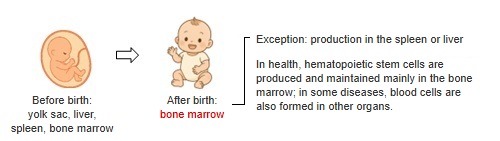
· In disease, the spleen and liver can take up blood formation again (extramedullary hematopoiesis).
A hematopoietic stem cell takes one of three paths in the bone marrow: self-renewal, differentiation, or a resting (quiescent) state.
- Self-renewal : it divides and copies itself (daughter cells), increasing its numbers
- Differentiation : it differentiates into the blood cell components (white blood cells, red blood cells, platelets) and so supplies new cells
- Resting state : it stays at rest as a reserve, in case the dividing and differentiating cells run out; probably the largest share of the stem cells
Why some stem cells stay at rest
Is it necessary to have resting stem cells when self-renewal is so active?
Yes. Resting (quiescent) hematopoietic stem cells are very important even while other stem cells are actively renewing themselves.
There are several reasons:
1. 1. Keeping the stem-cell pool from running out
· Each division of a stem cell adds a little damage, such as chromosome damage and shortening of the telomeres, so errors and ageing of the DNA build up.
· If all the stem cells were dividing or differentiating all the time, the pool would shrink in the long run.
· Resting stem cells keep the pool in reserve, as "spare" stem cells.
2. 2. Readiness for stress
· When many blood cells are needed at once, for example after bleeding or in an infection, resting stem cells are activated and start to divide and differentiate.
· Their presence gives a reserve that can meet a sudden demand.
3. 3. Balance between speed and safety
· Actively dividing stem cells alone could supply the blood cells, but the risk of DNA damage and mutation would rise.
· By not dividing, resting stem cells keep the stem-cell pool stable and safe over the long term.
4. 4. In short
Even when self-renewal is active, resting stem cells are essential: they preserve the stem-cell pool, give a reserve for times of stress and keep the genetic information safe.
Is it known what share of the stem cells is resting?
In part, from studies in animals, mainly mice. In mouse bone marrow most long-term hematopoietic stem cells (LT-HSC) are at rest, in the G0 phase of the cell cycle, at any one time; only a smaller share is dividing.
Short-term stem cells (ST-HSC) and multipotent progenitors (MPP) divide more actively,
so a smaller share of them is at rest.
In humans the exact share is hard to measure, but here too most long-term stem cells are thought to be resting, and the share changes with age and health. Not all stem cells are renewing themselves at any one time: they are activated only when division or differentiation is needed. In summary:
| Type of stem cell | Share at rest (G0 phase) | Comment |
|---|---|---|
| Long-term HSC (LT-HSC) | Most | Mainly the reserve pool |
| Short-term HSC (ST-HSC) | Fewer | Divide more actively |
| Multipotent progenitor (MPP) | Very few | Specialised in supplying blood cells |
Self-renewal
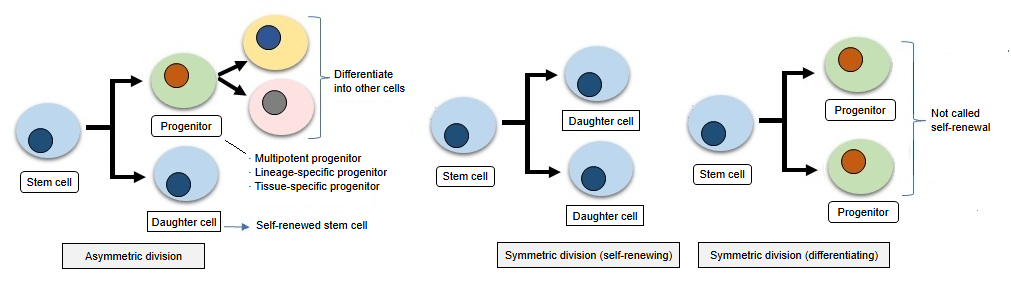
· Hematopoietic stem cells can increase their own numbers by themselves; this is called self-renewal.
· Self-renewal takes two forms:
Asymmetric division: one daughter stays a stem cell (a copy of itself), and the other becomes a progenitor cell that goes on to differentiate.
Symmetric (self-renewing) division: both daughters stay stem cells, enlarging the pool.
A third form, symmetric (differentiating) division, gives two progenitor cells; it is not counted as self-renewal.
· Self-renewal does not go on all the time: it is set by the body's needs (for example after bleeding or infection), and it continues throughout life.
Differentiation
A hematopoietic stem cell can differentiate into every kind of blood cell. It does not differentiate all the time, only under certain conditions.
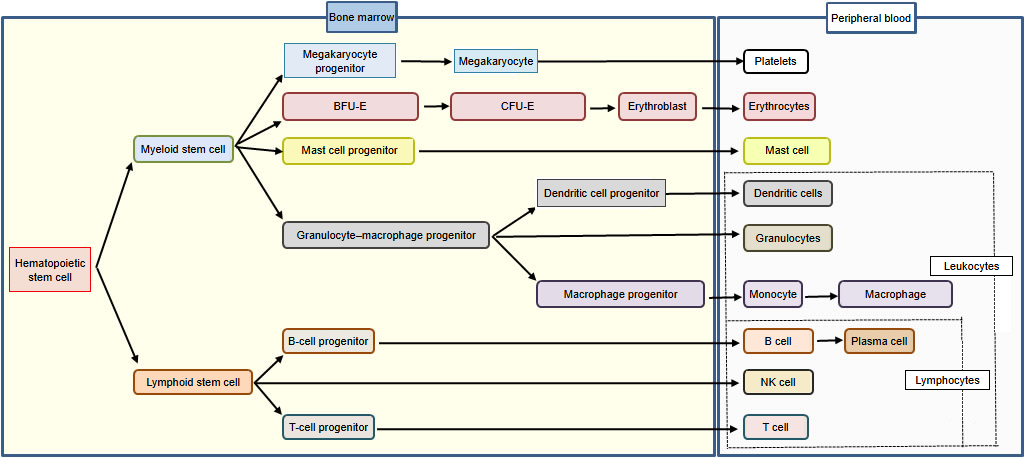
Hematopoietic stem cells differentiate along two routes: one through the common myeloid progenitor, the other through the common lymphoid progenitor.
- Common myeloid progenitor : (= myeloid stem cell) differentiates into red blood cells, platelets, granulocytes and monocytes
- Common lymphoid progenitor : (= lymphoid stem cell) differentiates into B cells, T cells and NK cells
· Myeloid line: erythrocytes (through the early and late erythroid progenitors, BFU-E and CFU-E, and erythroblasts), platelets (from megakaryocytes), granulocytes, monocytes/macrophages and mast cells.
· Lymphoid line: B lymphocytes (which can become plasma cells), T lymphocytes (which finish maturing in the thymus) and NK cells.
· Dendritic cells can arise from both lines. Sources differ on the exact branching of the early progenitors.
Hematopoietic stem cell niche
Why it is needed
In the adult bone marrow tens to hundreds of billions of blood cells are made every day from hematopoietic stem cells, yet the stem cells at the source are very few:
Hematopoietic stem cells are thought to make up only about 1 in 10,000 to 1 in 1,000,000 of all bone marrow cells (sources differ).
The niche is the mechanism that protects these few stem cells so that they are not used up.
Types
Two kinds of niche are recognised, according to where they lie:
Osteoblastic niche (endosteal niche)
Location: near the inner surface of the bone (the endosteum).
Main cells: osteoblasts, osteocytes and stromal cells.
Role: keeps the stem cells in a resting state.
Maintains the stem cells over the long term, acting like a "store". The stem cells here lie in poorly perfused, low-oxygen areas, which helps keep them at rest.
Vascular niche (perivascular niche)
Apart from the endosteal surface, hematopoietic stem cells in the bone marrow also sit on the endothelial cells of the marrow sinusoids, together with CXCL12-abundant reticular (CAR) cells. This is the vascular niche. Besides maintaining the stem cells, it is much involved in their division and in their differentiation into blood cells.
These sinusoids lie in the marrow cavity itself; they are not the vessels of the osteonal (Haversian) canals of compact bone. Sources differ on how separate the two niches really are.
Related terms
References and sources
- Further reading: Hematopoietic stem cell, Wikipedia.
- Further reading: Haematopoiesis, Wikipedia.
- Further reading: Hematopoietic stem cell niche, Wikipedia.
- Federative International Programme for Anatomical Terminology (FIPAT). Terminologia Anatomica, 2nd ed. (TA2), 2019.