Horizontal cell
of the
optic part
of the
retina
- Nerve cells (neurons)
- Photoreceptor cells : rod cells (the great majority) and cone cells.
- Others : horizontal cells, bipolar cells, amacrine cells and ganglion cells.
- Cells of the supporting tissue (a kind of glial cell)
- Müller cells : span the retina like props and support it.
- Neuroglia : fill the spaces between the nerve cells and support them.
Where horizontal cells act
The direct pathway runs from the photoreceptors to the bipolar cells and on to the ganglion cells; horizontal cells act on it from the side. Their selective contacts with the different kinds of cone also turn the three-colour signal into colour-opponent signals.
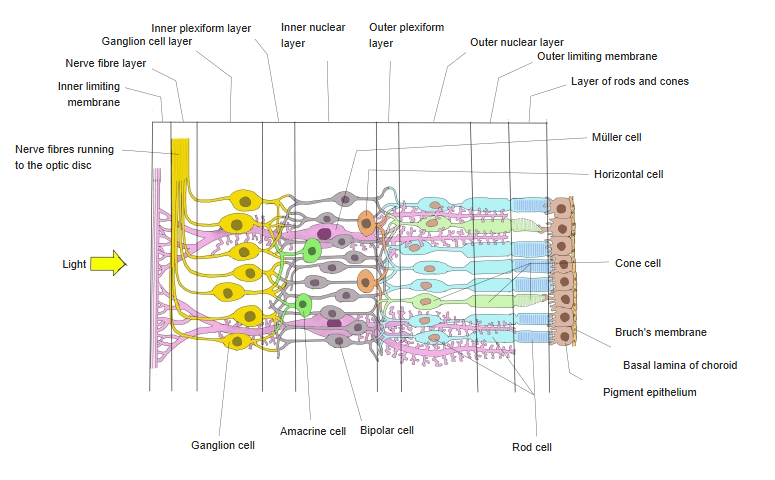
· Its cell body lies in the outer part of the inner nuclear layer (inner granular layer); its processes spread in the outer plexiform layer, where they contact the synaptic terminals of rod cells and cone cells (at the end opposite their light-sensitive outer segments).
· It is one of the five main kinds of retinal neuron, with the photoreceptor cells, bipolar cells, amacrine cells and ganglion cells (all in the optic part of the retina). The Müller cells are glial cells, not neurons.
· Through this lateral inhibition it increases contrast, helps the retina adjust to bright and dim light, and gives ganglion cells their centre–surround receptive fields.
 Structure of the retina
- 1st to 3rd neurons
Reference websites
[Wikipedia]
· Retina horizontal cell, Wikipedia.
· Retina, Wikipedia.
[Websites with illustrations]
· Cells of the retina (Tufts University)
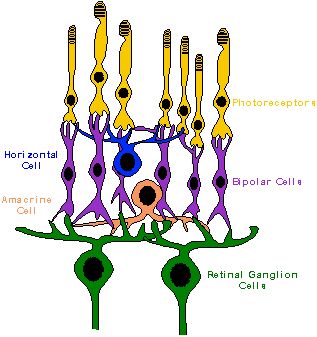
· Horizontal cells and lateral inhibition (image on squarespace-cdn.com)
Related terms
- Neuron
- Retina
- Rod cell
- Retinal ganglion cell
- Müller cell
- Optic part of retina
- Outer segment of photoreceptor
References and sources
- Further reading: Retina horizontal cell, Wikipedia.
- Further reading: Retina, Wikipedia.
- Federative International Programme for Anatomical Terminology (FIPAT). Terminologia Anatomica, 2nd ed. (TA2), 2019.