Retromandibular region (Latin: regio retromandibularis)
Also called the retromandibular fossa
The retromandibular region
The masseteric region lies in front of it, the auricular region above it and the sternocleidomastoid region behind it; the angle of the mandible marks its lower front corner. Deep to it is the retromandibular fossa, filled mainly by the deep part of the parotid gland; the retromandibular vein, the external carotid artery and the facial nerve run through the gland here. Systems of body regions differ between sources; some include this area in the parotid or masseteric region.
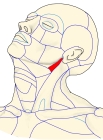 Retromandibular region
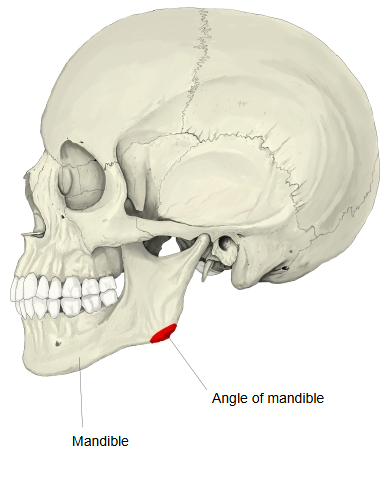
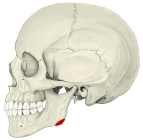 Angle of mandible
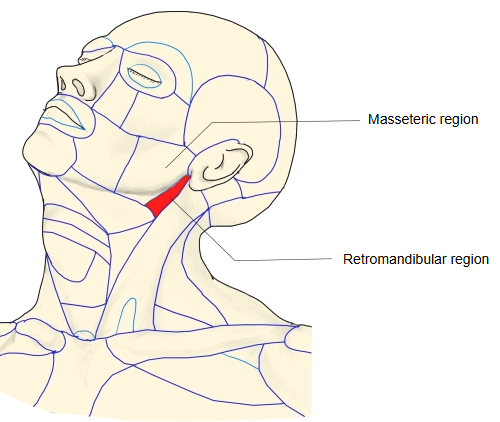
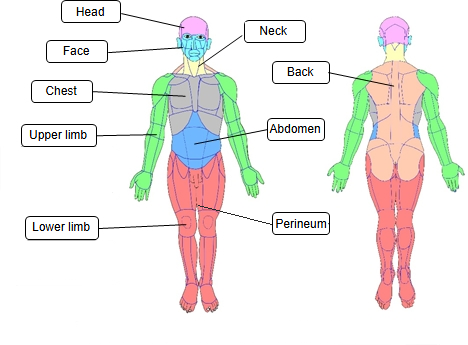
On this site the body is divided into three main parts, the head and neck, the trunk and the limbs, and the limbs into the upper and lower limbs. Each part is divided further into smaller regions.
of the
body
- Head and neck : 1. head (head, face) 2. neck
- Trunk : 1. chest 2. abdomen 3. back
- Limbs
- Upper limb : 1. shoulder 2. arm 3. elbow 4. forearm 5. hand
- Lower limb : 1. perineum 2. thigh 3. knee 4. leg 5. foot
Related terms
- Masseteric region
- Auricular region
- Sternocleidomastoid region
- Angle of mandible
- Ramus of mandible
- Parotid gland
- Retromandibular vein
References and sources
- Further reading: Parotid gland, Wikipedia.
- Federative International Programme for Anatomical Terminology (FIPAT). Terminologia Anatomica, 2nd ed. (TA2), 2019.