Angle of mandible (Latin: angulus mandibulae)
Also called the gonial angle
· The angle is sharpest in adults with a full set of teeth. It is wider (more obtuse) in the newborn and often becomes wider again in old age after the teeth are lost.
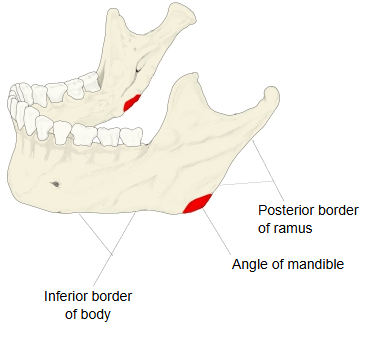
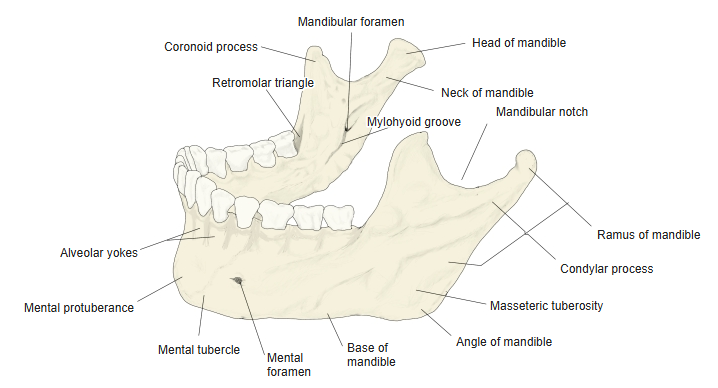
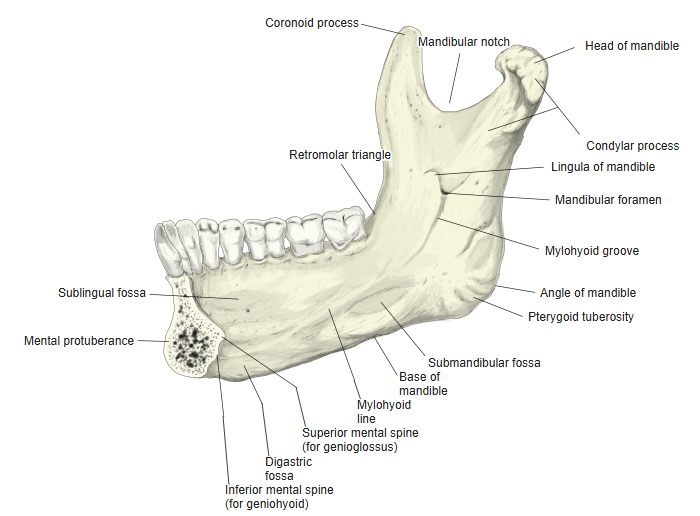
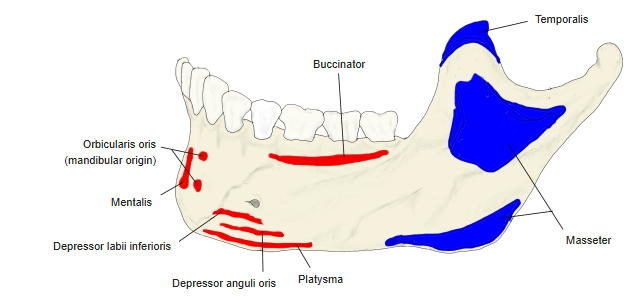
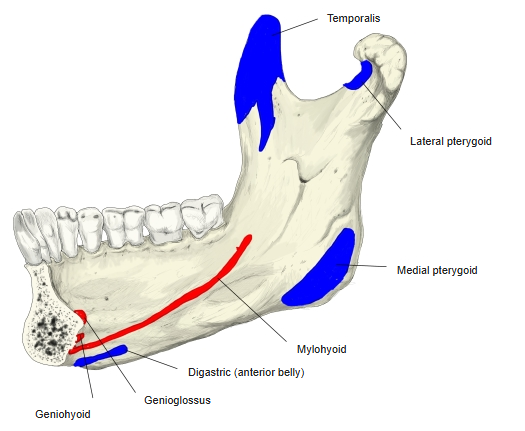
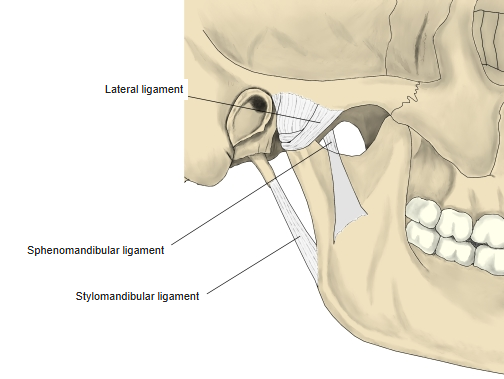
It is the thickened corner of the jaw that can be felt below and in front of the ear lobe. Its outer side bears rough oblique ridges, the masseteric tuberosity, for the masseter; its inner side bears the pterygoid tuberosity for the medial pterygoid. The stylomandibular ligament attaches to the angle between these two muscles.
The gonion is the lowest, most posterior and most lateral point of the angle, used as a landmark in cephalometry and forensic anatomy.
The angle may be turned outwards (everted) or inwards (inverted). Sources differ on how useful its size and shape are for telling male from female skulls.
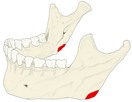 Angle of mandible
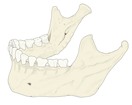 Mandible (oblique view)
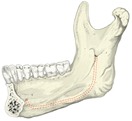 Right half of mandible (medial view)
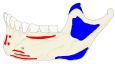 Mandible: muscle attachments (lateral surface)
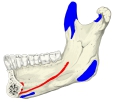 Mandible: muscle attachments (medial surface)
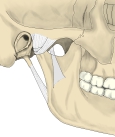 Ligaments of the temporomandibular joint
Reference websites
[Wikipedia]
· Angle of the mandible, Wikipedia.
· Mandible, Wikipedia.
[Websites with illustrations]
· The mandible (TeachMeAnatomy)
· Mandible, outer surface (Gray's Anatomy) (Wikimedia Commons)

· Mandible, inner surface (Gray's Anatomy) (Wikimedia Commons)

Where it is found
Related terms
- Ramus of mandible
- Body of mandible
- Condylar process
- Coronoid process
- Mandibular foramen
- Temporomandibular joint
- Mandible
References and sources
- Further reading: Angle of the mandible, Wikipedia.
- Further reading: Mandible, Wikipedia.
- Federative International Programme for Anatomical Terminology (FIPAT). Terminologia Anatomica, 2nd ed. (TA2), 2019.