Nerve terminal
Also called the nerve ending
 Nerve terminal
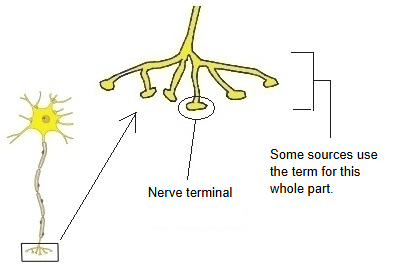
It is the end of a nerve fibre. Some fibres simply become thinner and end without any special structure (free nerve endings); others end in some kind of end apparatus, such as an encapsulated sensory receptor or a motor end plate. Where a nerve terminal connects with another neuron, the junction is called a synapse. Near its end the fibre loses its myelin sheath and its sheath of supporting cells and becomes a bare axon.
The term usually means the enlarged end of each terminal branch shown in the figure, but some sources use it for the whole branching part beyond the point where the axon divides. In English, the swollen end with its end apparatus is called a nerve ending, terminal bouton or axon terminal; nerve terminal and axon terminal are often used as synonyms (see also chemical synapse).
Reference websites
[Wikipedia]
· Axon terminal, Wikipedia.
· Free nerve ending, Wikipedia.
Related terms
References and sources
- Further reading: Free nerve ending, Wikipedia.
- Further reading: Axon terminal, Wikipedia.
- Federative International Programme for Anatomical Terminology (FIPAT). Terminologia Anatomica, 2nd ed. (TA2), 2019.