Myelin sheath
· Axons with this covering are myelinated nerve fibres; axons without it are unmyelinated. Almost all fibres of the white matter are myelinated, but many fibres of the peripheral nerves, especially autonomic ones, are unmyelinated.
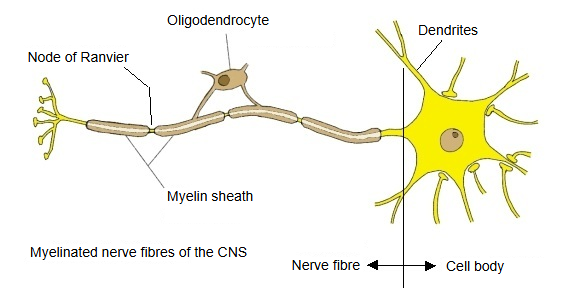
· The sheath is not continuous: it is made of segments separated by short gaps, the nodes of Ranvier.
· By dry weight it is about 70–80% lipid (phospholipids, glycolipids and cholesterol) and 20–30% protein, such as myelin basic protein and proteolipid protein.
· Its thickness tends to increase with the diameter of the axon.
· Functions: it insulates the axon so that the impulse jumps from node to node (saltatory conduction), which makes conduction much faster and saves energy; it also protects the axon.
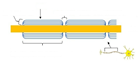 Structure of the myelin sheath
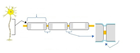 Myelin segments and nodes
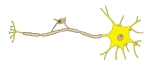 Oligodendrocyte (CNS)
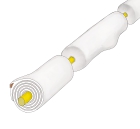 Schwann cell (PNS)
 Myelinated neuron
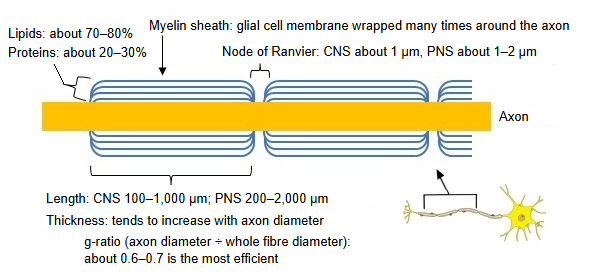
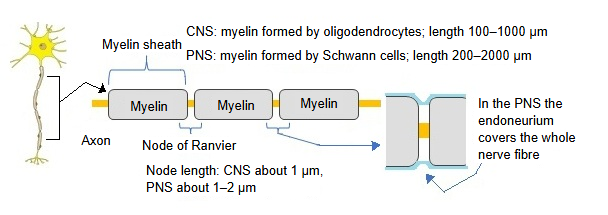
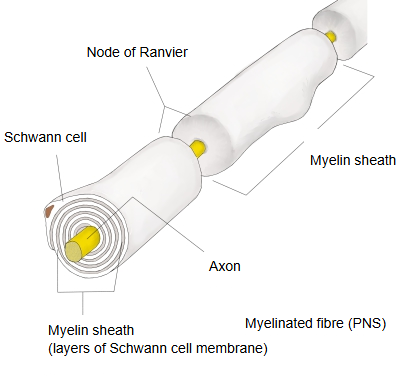
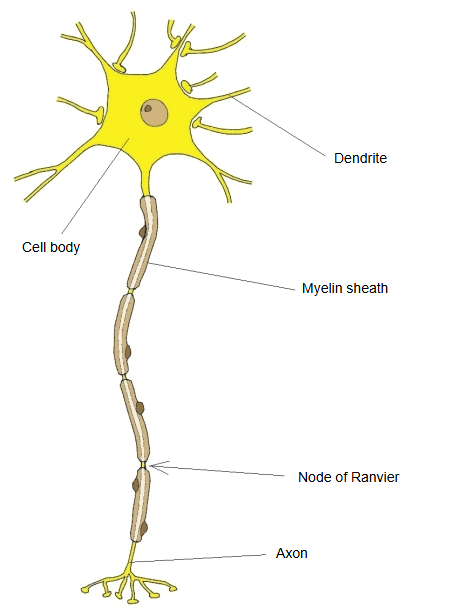
Note: sources differ on the measurements of myelin segments and nodes; the values below are typical ranges.
[Myelin in the central nervous system]
· Formed by oligodendrocytes.
· The cell body lies a little away from the axons, in the white matter, and its processes each form a segment of myelin, so one oligodendrocyte myelinates several axons.
· Segments are about 100–1,000 µm long; nodes are about 1 µm.
[Myelin in the peripheral nervous system]
· Formed by Schwann cells; each Schwann cell forms one segment on one axon.
· The nucleus and most of the cytoplasm stay in the outermost layer (the neurilemma).
· Segments are about 200–2,000 µm long; nodes are about 1–2 µm. The endoneurium covers the whole fibre.
Related terms
- Axon
- Node of Ranvier
- Schwann cell
- Saltatory conduction
- Myelinated nerve fibre
- Unmyelinated nerve fibre
- Neuroglia
References and sources
- Further reading: Myelin, Wikipedia.
- Federative International Programme for Anatomical Terminology (FIPAT). Terminologia Anatomica, 2nd ed. (TA2), 2019.