Hematopoietic organ
Also called: haematopoietic organ; blood-forming organ
What is a hematopoietic organ?
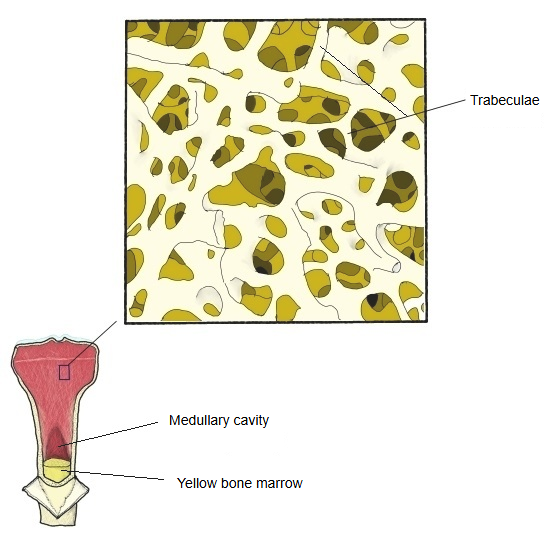
Also called a blood-forming organ.The hematopoietic organs change with growth. Fetus: liver, spleen and bone marrow. After birth: bone marrow (red bone marrow, mainly in the spaces between the trabeculae of spongy bone).Lymphocytes also mature and multiply in the lymphoid organs (thymus, lymph nodes, spleen), which some sources count among the hematopoietic organs.
The changes of the hematopoietic organs before birth in more detail:
| Prenatal period | Early embryo | Blood formation begins in the yolk sac. In the third week, mesenchymal cells in the wall of the yolk sac gather into blood islands, which produce the first red blood cells (these still have a nucleus). |
| From the second month | The liver becomes the main site and makes nucleated red blood cells; the spleen joins later and contributes much less than the liver. | |
| Middle of the fetal period | Blood formation begins in the bone marrow (from about the fifth month). | |
| From about the sixth month | Blood formation in the bone marrow increases quickly, and the marrow becomes the main site by birth. |
Related terms
References and sources
- Further reading: Haematopoiesis, Wikipedia.
- Federative International Programme for Anatomical Terminology (FIPAT). Terminologia Anatomica, 2nd ed. (TA2), 2019.