Highest nuchal line (Latin: linea nuchalis suprema)
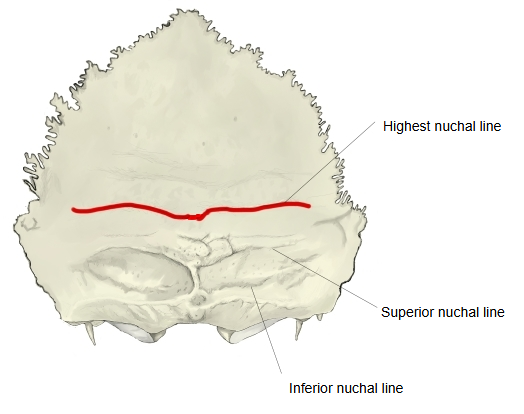
The highest nuchal line is a faint curved ridge on the outer surface of the occipital squama, a little above the superior nuchal line. The uppermost fibres of trapezius are said to arise from it in some descriptions.
On each side it runs inwards to the external occipital protuberance, where it meets the upper end of the external occipital crest. It gives attachment to the epicranial aponeurosis and, in its lateral part, to the occipitalis (occipital belly of occipitofrontalis).
From the external occipital protuberance it arches outwards and slightly upwards, above the superior nuchal line. It is often indistinct and may be absent; it is best seen on strongly marked skulls.
Sources differ on the attachment of trapezius: most texts give the medial third of the superior nuchal line and the external occipital protuberance, and only some include the highest nuchal line.
Trapezius is a flat muscle whose thickness varies from part to part. At the skull it arises by a thin tendon from the medial part of the nuchal lines and the external occipital protuberance, and below them from the nuchal ligament.
Reference websites
[Wikipedia]
· Nuchal lines, Wikipedia.
· Occipital bone, Wikipedia.
[Websites with illustrations]
· Occipital bone, outer surface (Gray's Anatomy, fig. 129) (Wikimedia Commons)

· Base of the skull, outer surface (Gray's Anatomy, fig. 187) (Wikimedia Commons)

· Bones of the skull (TeachMeAnatomy)
Related terms
- Superior nuchal line
- Inferior nuchal line
- External occipital protuberance
- External occipital crest
- Occipital squama
- Epicranial aponeurosis
- Nuchal plane
References and sources
- Further reading: Nuchal lines, Wikipedia.
- Further reading: Occipital bone, Wikipedia.
- Federative International Programme for Anatomical Terminology (FIPAT). Terminologia Anatomica, 2nd ed. (TA2), 2019.