Latin: venter occipitalis musculi occipitofrontalis · also: occipital belly
Overview
- One of the facial muscles (a skin muscle), in the group of the epicranius.
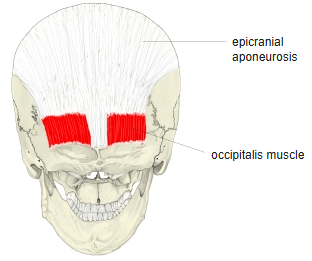
- A thin, quadrilateral muscle at the back of the head.
- Many sources, including Terminologia Anatomica, treat it as the occipital belly of the occipitofrontalis, together with the frontal belly (frontalis); both bellies pass into the epicranial aponeurosis.
- Generally rudimentary, with a weak action.
Position in the classification
Head › Facial muscles › Epicranius
- Frontalis
- Occipitalis
- Temporoparietalis
Illustrations
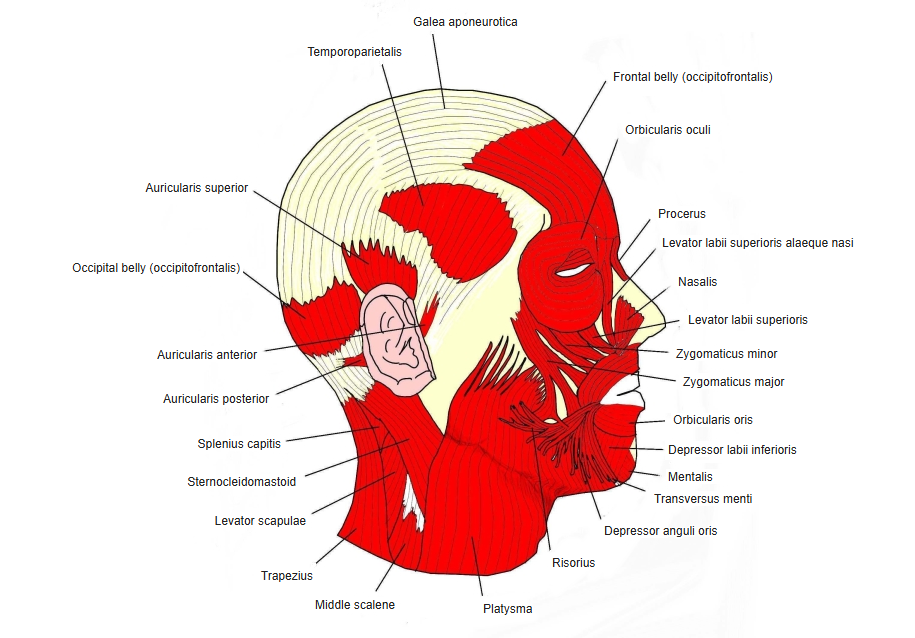
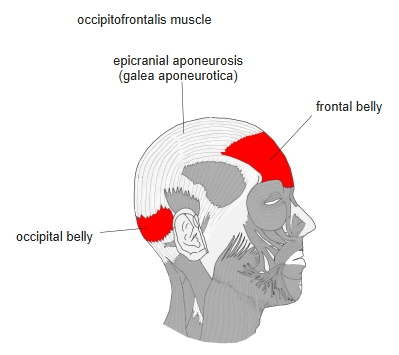
Origin / insertion
- Origin: superior nuchal line and highest nuchal line of the occipital bone (lateral two-thirds), and the mastoid part of the temporal bone; 25–30 mm away from the midline
- Runs obliquely upward and laterally.
- Insertion: epicranial aponeurosis
Action
- Pulls the epicranial aponeurosis backward (moves the scalp back) and smooths the skin of the forehead
Innervation
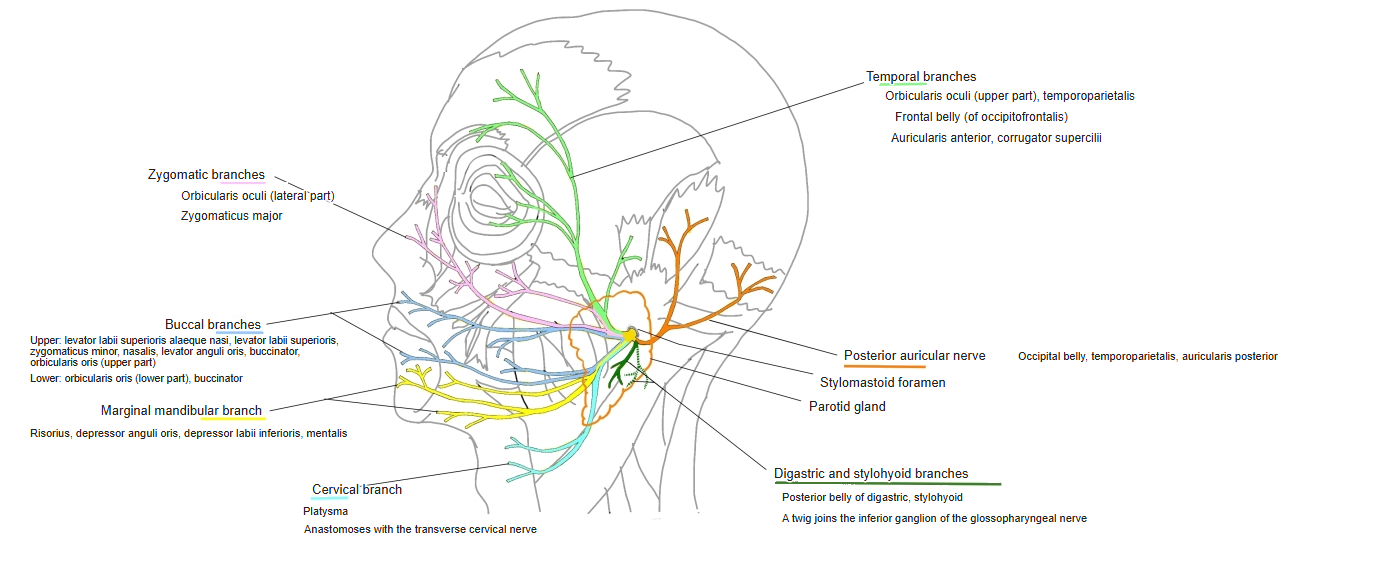
- Facial nerve: occipital branch of the posterior auricular nerve
Blood supply
- Occipital artery
- Veins: probably the occipital vein; no source describing it was found.
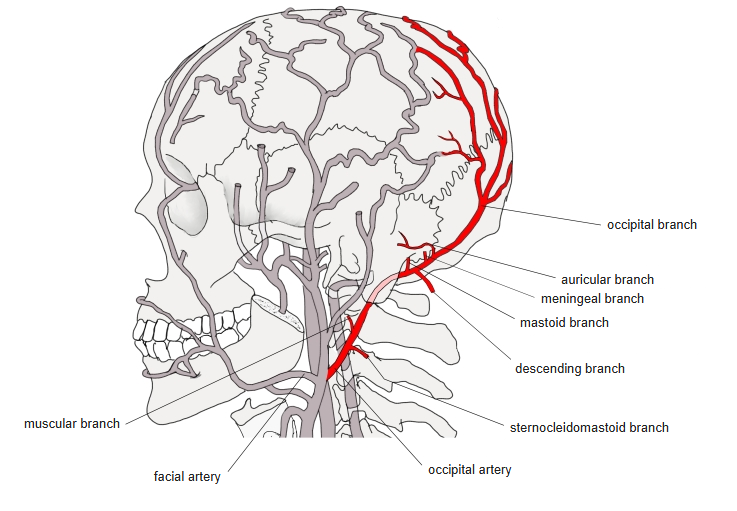
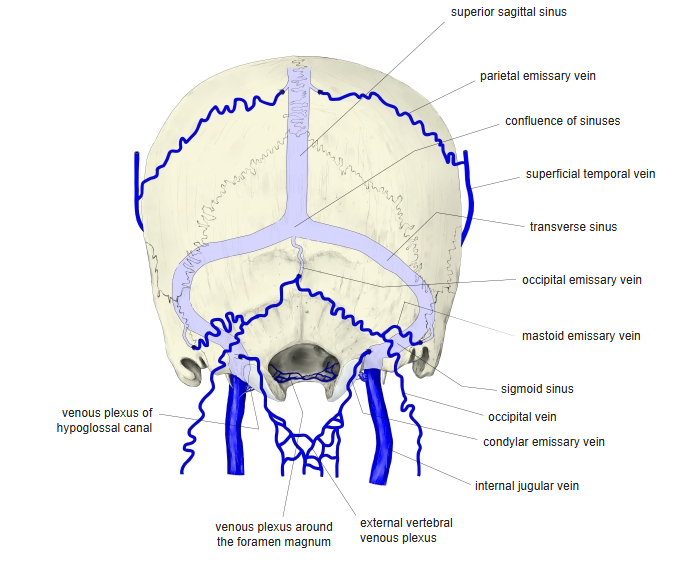
The branching points in the occipital artery figure follow various published illustrations and differ between them; treat them as approximate.
Anatomical variations
- May be completely absent
- The muscles of the two sides may cross in the midline
- Often continuous with the auricularis posterior (nuchal-auricular part)
Related terms
- Occipitofrontalis
- Frontal belly (frontalis)
- Epicranius
- Epicranial aponeurosis
- Superior nuchal line
- Occipital artery
- Facial nerve
References and sources
- Further reading: Occipitalis muscle, Wikipedia — also the source for the blood supply.