Posterior tubercle of atlas (Latin: tuberculum posterius atlantis)
A small elevation at the back end of the posterior arch of the atlas; it is a reduced spinous process.
Attachments: rectus capitis posterior minor and the nuchal ligament; the posterior atlanto-occipital membrane is attached to the upper border of the arch beside it
The 2nd and lower cervical vertebrae also have a part with the same name, the posterior tubercle, but it lies in a quite different place (the back end of the transverse process); do not confuse the two.
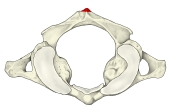 Atlas, superior view
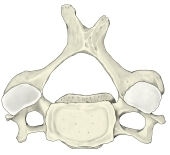 Fourth cervical vertebra, superior view
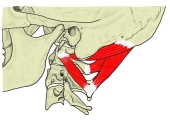 Suboccipital muscles
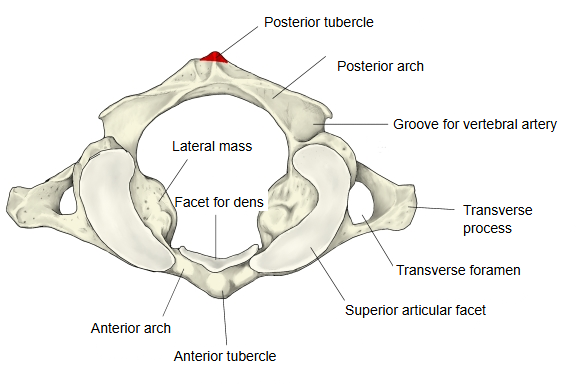
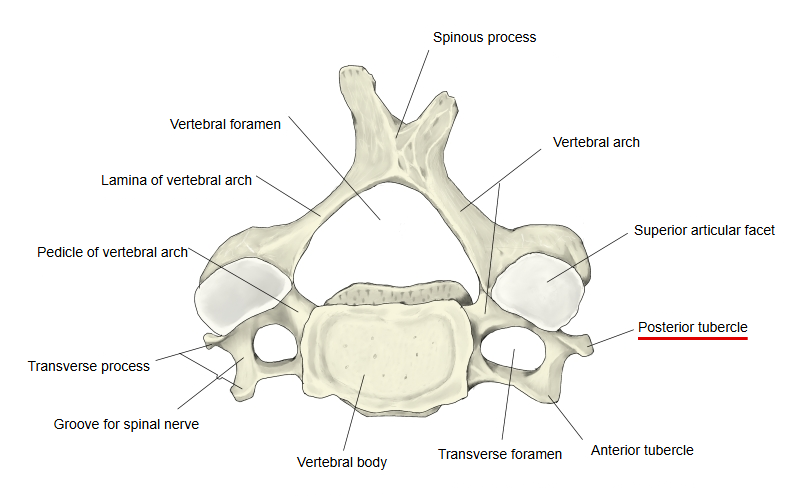
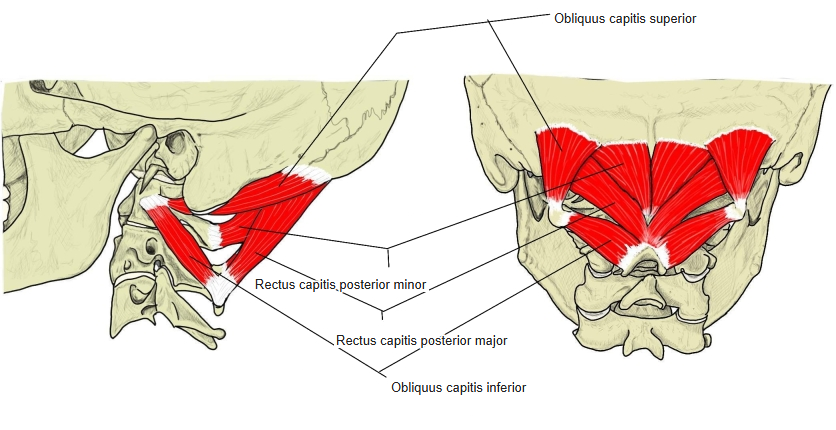
It is the backward-pointing projection at the top of the posterior arch, a rudimentary spinous process. The rectus capitis posterior minor muscles of both sides arise from it.
Reference websites
[Wikipedia]
· Atlas (anatomy), Wikipedia.
[Websites with illustrations]
· First cervical vertebra, or atlas (Gray's Anatomy, fig. 86) (Wikimedia Commons)

· Cervical spine: anatomy, ligaments, nerves and injury (Kenhub)
Related terms
- Posterior arch of atlas
- Anterior tubercle of atlas
- Anterior arch of atlas
- Lateral mass of atlas
- Posterior atlanto-occipital membrane
- Atlas
References and sources
- Further reading: Atlas (anatomy), Wikipedia.
- Federative International Programme for Anatomical Terminology (FIPAT). Terminologia Anatomica, 2nd ed. (TA2), 2019.