Nipple (Latin: papilla mammaria)
Also called: mammary papilla
· The ring-shaped area around the nipple is the areola; in pregnancy and after childbirth its pigment increases and it turns dark brown.
· The nipple and areola have no fat. They are made of dense connective tissue carrying blood vessels and lactiferous ducts, with well-developed sebaceous glands and smooth muscle.
- Surface
- Skin : covers almost the whole surface of the breast.
- Nipple : in women, the cylindrical projection slightly below the centre of the breast; milk is secreted through it.
- Areola : the ring-shaped area around the nipple, with small nodules formed by the areolar glands.
- Inside
- Body of breast
- Mammary fat body : makes up most of the bulk of the breast (in varying proportion); contains bundles of connective-tissue fibres.
- Mammary gland
- Lobes : groups of lobules; about 15–20, arranged radially around the nipple.
- Lactiferous ducts : carry the milk made in the lobules to the nipple.
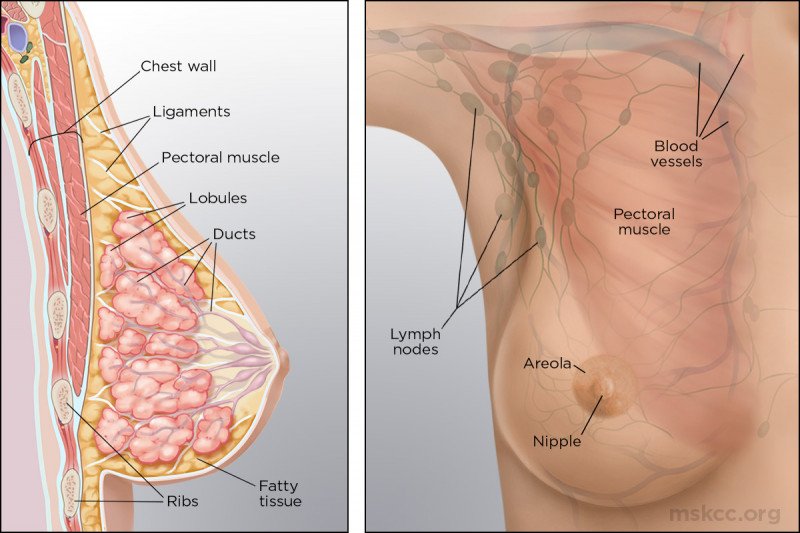
- Suspensory ligaments : (Cooper's ligaments) run between the fascia and the skin and keep the shape of the breast.
- Others : arteries: internal thoracic, lateral thoracic and intercostal branches; nerves: intercostal nerves, supraclavicular nerves and others.
- Body of breast
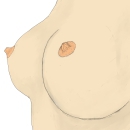 Breast
 Areola
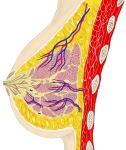 Breast (sagittal section)
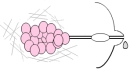 Mammary lobe (model 1)
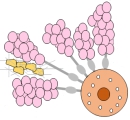 Mammary lobes (model 2)
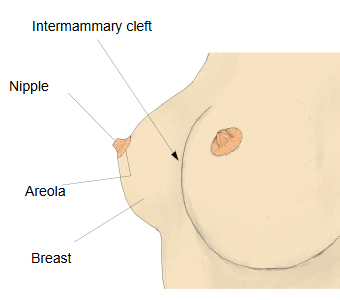
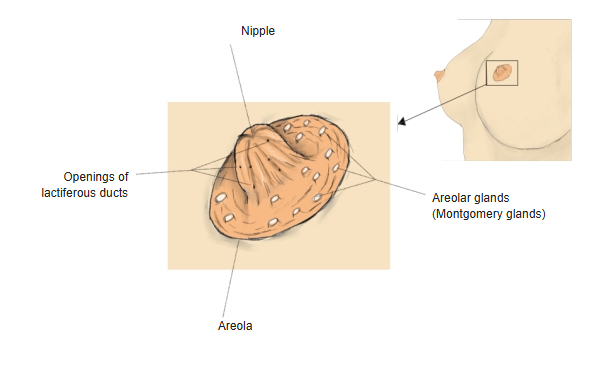
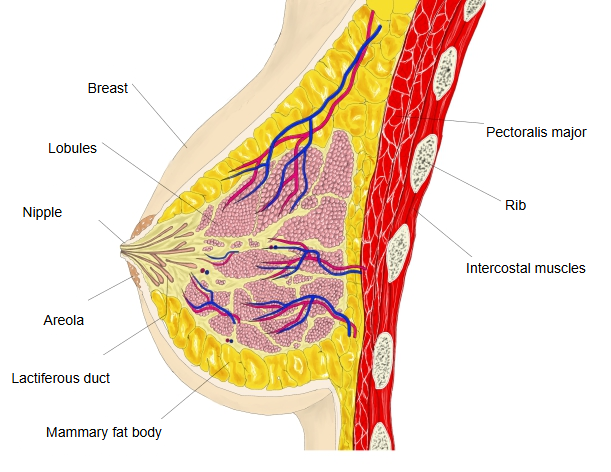
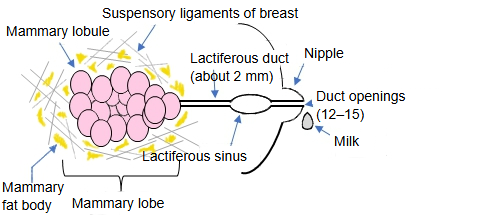
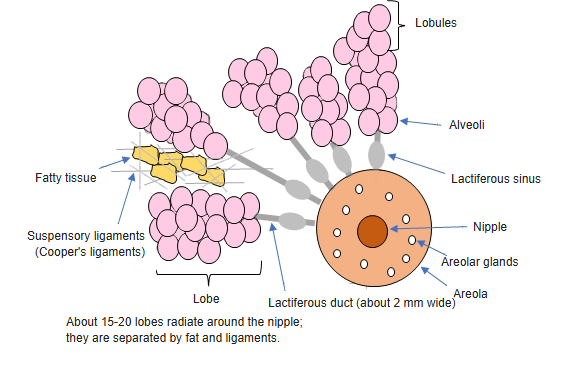
The nipple is the wart-like projection at the tip of the breast, and the lactiferous ducts open on its surface. It usually lies at about the fourth intercostal space in the midclavicular line, but its position varies considerably between individuals. In men the breast is generally undeveloped, with only a small nipple and areola. In women the breast develops after puberty, and its size and shape vary greatly between individuals; this depends less on the development of the mammary gland than mainly on the amount of adipose tissue.
Reference websites
[Wikipedia]
· Nipple, Wikipedia.
[Websites with illustrations]
· Anatomy of the female breast (illustration) (American College of Surgeons)

· Breast anatomy (illustration) (Memorial Sloan Kettering Cancer Center)
Related terms
- Areola
- Areolar glands
- Openings of lactiferous ducts
- Lactiferous duct
- Lactiferous sinus
- Body of breast
- Accessory breast
References and sources
- Further reading: Nipple, Wikipedia.
- Federative International Programme for Anatomical Terminology (FIPAT). Terminologia Anatomica, 2nd ed. (TA2), 2019.